


Page 586 - Instrumentation Reference Book 3E
P. 586
568  Non-destructive testing


                                                             (b)
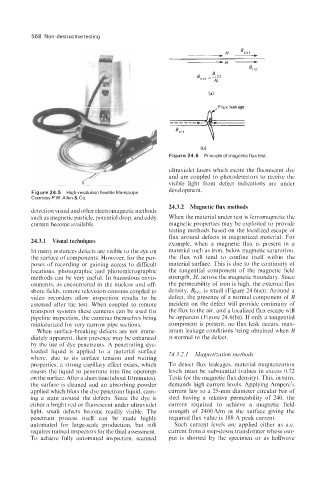
                                                    Figure 24.6  Principleof magneticflux test
                                                   ultraviolet lasers which excite the fluorescent dye
                                                   and are coupled to photodetectors  to receive the
                                                   visible  light  from  defect  indications  are  under
                                                   development.
           Figure 24.5  High-resolution flexible fiberscope.
          Courtesy P.W. Allen & Co.
                                                   24.3.2  Magnetic flux methods
          detection visual and other electromagnetic methods
          such as magnetic particle, potential drop, and eddy   When the material under test is ferromagnetic the
          current become available.                magnetic properties may be exploited to provide
                                                   testing methods based on the localized escape of
                                                   flux around defects in magnetized material.  For
          24.3.1  Visual techniques                example,  when  a  magnetic  flux  is  present  in  a
          In many instances defects are visible to the eye on   material such as iron, below magnetic saturation,
          the surface of components. However, for the pur-   the  flux  will  tend  to  confine  itself  within  the
          poses of  recording  or gaining access to difficult   material surface. This is due to the continuity of
          locations,  photographic  and  photomicrographic   the  tangential  component  of  the magnetic  field
          methods can be very useful. In hazardous envir-   strength, H, across the magnetic boundary. Since
          onments, as encountered  in the nuclear and off-   the permeability of iron is high, the external flux
          shore fields, remote television cameras coupled to   density, BeXt, is small (Figure 24.6(a)). Around a
          video  recorders  allow  inspection  results  to  be   defect, the presence of a normal component of B
          assessed after the test.  When coupled  to remote   incident on the defect will  provide continuity of
          transport  systems these cameras can be  used for   the flux to the air, and a localized flux escape will
          pipeline inspection, the cameras themselves being   be apparent (Figure 24.6(b)). If only a tangential
          miniaturized for very narrow pipe sections.   component is present,  no flux leak occurs, max-
            When  surface-breaking  defects are not imme-   imum leakage conditions being obtained when B
          diately apparent. their presence may be enhanced   is normal to the defect.
          by  the use of dye penetrants. A penetrating dye-
          loaded  liquid  is  applied  to  a  material  surface   24.3.2.1  Magnetization  methods
          where,  due  to  its  surface  tension  and  wetting
          properties,  a strong capillary effect exists, which   To detect  flux leakages, material  magnetization
          causes the liquid to penetrate into fine openings   levels  must  be  substantial  (values in  excess 0.72
          on the surface. After a short time (about 10 minutes),   Tesla for the magnetic flux density). This. in turn,
          the surface is cleaned and an absorbing powder   demands high current levels. Applying Ampere's
          applied which blots the dye penetrant liquid, caus-   current law to a 25-mm diameter circular bar of
          ing a  stain  around  the  defects.  Since the  dye  is   steel having  a  relative  permeability  of  240,  the
          either a bright red or fluorescent under ultraviolet   current  required  to  achieve  a  magnetic  field
          light,  small  defects  become  readily  visible.  The   strength  of  2400Nm  at  the  surface  giving  the
          penetrant  process  itself  can  be  made  highly   required flux value is 188 A peak current.
          automated  for  large-scale  production,  but  still   Such  current  levels are  applied  either  as  a.c.
          requires trained inspectors for the final assessment.   current from a step-down transformer whose out-
          To  achieve fully  automated  inspection,  scanned   put  is  shorted  by  the  specimen or  as  halfwave

