


Page 584 - Instrumentation Reference Book 3E
P. 584
24  Non-destructive testing


             SCOTTISH SCHOOL OF NON-DESTRUCTIVE TESTING


             24.1  Introduction                         Non-destructive testing is not confined to manu-
                                                      facture. The designer and user may find applica-
             The driving force for improvements and develop-   tion to on-site testing of bridges, pipelines in the
             ments in non-destructive  testing instrumentation   oil  and  gas  industries,  pressure  vessels  in  the
             is the continually increasing need to demonstrate   power-generation industry, and in-service testing
             the integrity and reliability of engineering mater-   of  nuclear  plant,  aircraft,  and  refinery  installa-
             ials, products, and plant. Efficient materials manu-   tions.  Defects at this stage may be deterioration
             facture,  the  assurance  of  product  quality,  and   in plant due to fatigue and corrosion.
             re-assurance of plant at regular intervals during use   The purpose of non-destructive  testing during
             represent the main need for non-destructive test-   service  is  to  look  for  deterioration  in  plant  to
             ing  (NDT).  This  “state-of-health’’ knowledge is   ensure that adequate warning is given of the need
             necessary for both economic and safety reasons.   to  repair  or  replace.  Periodic  checks  also  give
             Indeed,  in  the  UK  the  latter  reasons  have  been   confidence that “all is well.”
             strengthened  by  legislation  such  as  the  Health   In these ways, therefore,  non-destructive  test-
             and Safety at Work Act  1974, and in the United   ing plays an important role  in  the manufacture
             States  by  the  Occupational  Safety  and  Health   and  use  of  materials.  Moreover,  as  designs
             Administration (OSHA).                   become more adventurous  and as new materials
               Failures  in  engineering components  generally   are used, there is less justification for relying on
             result from a combination of conditions, the main   past  experience.  Accordingly,  non-destructive
             three  being inadequate  design, incorrect  use,  or   testing has an increasingly important role.
             the presence of  defects in materials.  The  use  of   Methods  of  non-destructive  testing  are  nor-
             non-destructive testing seeks to eliminate the fail-   mally categorized in terms of whether their  suit-
             ures  caused  predominantly  by  defects.  During   ability  is  primarily  for  the  examination  of  the
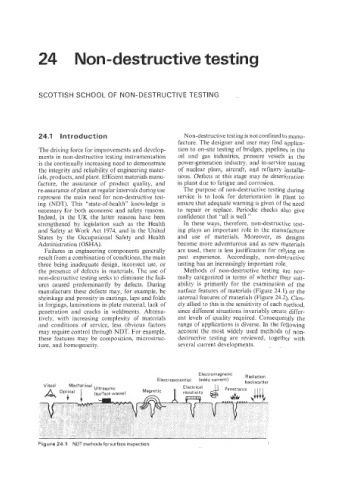
             manufacture  these defects may,  for example, be   surface features of materials (Figure 24.1) or the
             shrinkage and porosity in castings, laps and folds   internal features of materials (Figure 24.2). Clos-
             in forgings, laminations in plate material, lack of   ely allied to this is the sensitivity of each method,
             penetration  and  cracks  in  weldments.  Alterna-   since different situations invariably create differ-
             tively,  with  increasing  complexity  of  materials   ent  levels of quality required.  Consequently  the
             and  conditions  of  service, less  obvious  factors   range of applications is diverse. In the following
             may require control through NDT. For example,   account  the most  widely used  methods  of  non-
             these  features  may  be  composition, microstruc-   destructive  testing  are  reviewed,  together  with
             ture, and homogeneity.                   several current developments.


              Visual


             Figure 24.1 NDT methods for surface inspection.

