


Page 580 - Instrumentation Reference Book 3E
P. 580
562  Measurements employing nuclear techniques

            backscattered  and  measurable  by  the  detector.
            Once a coating has been applied  to the roll the
            intensity of the backscattered radiation returning
            to the detector will change. This change is a meas-
            ure of the thickness of the coating. Typical appli-
            cations  of  this  gauge  are  the  measurement  of
            rubber and adhesives on calenders, paper on roll-
            ers, or lacquer, paint, or plastics coatings applied
            to sheet steel.

            Measurement  of  coating  and  backing  by  X-ray
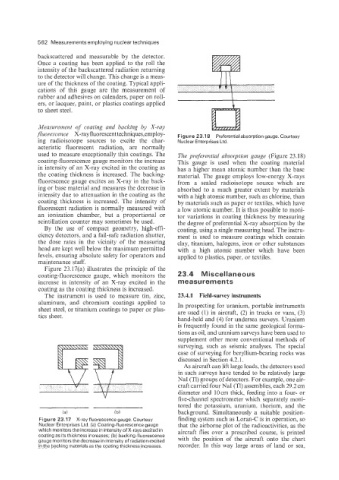
            fluorescence  X-rayfluorescenttechniques,employ-   Figure 23.1 8  Preferential absorption gauge. Courtesy
            ing  radioisotope  sources  to  excite  the  char-   Nuclear Enterprises Ltd.
            acteristic  fluorescent  radiation,  are  normally
            used to measure exceptionally thin coatings. The   The preferential  absorption  gauge  (Figure 23.18)
            coating-fluorescence gauge monitors the increase   This  gauge  is  used  when  the  coating  material
            in intensity of an X-ray excited in the coating as   has a higher mean atomic number than the base
            the coating thickness is  increased. The  backing-   material.  The gauge employs low-energy X-rays
            fluorescence gauge excites an X-ray in the back-   from  a  sealed  radioisotope  source  which  are
            ing or base material and measures the decrease in   absorbed  to  a  much  greater extent by  materials
            intensity due to attenuation in the coating as the   with a high atomic number, such as chlorine, than
            coating  thickness  is  increased.  The  intensity  of   by materials such as paper or textiles, which have
            fluorescent radiation  is normally  measured  with   a low atomic number. It is thus possible to moni-
            an  ionization  chamber,  but  a  proportional  or   tor variations in coating thickness by  measuring
            scintillation counter may sometimes be used.   the degree of preferential X-ray absorption by the
              By  the  use  of  compact  geometry,  high-effi-   coating, using a single measuring head. The instru-
            ciency detectors, and a fail-safe radiation shutter,   ment  is used  to measure coatings which contain
            the  dose  rates  in  the  vicinity of  the  measuring   clay, titanium, halogens, iron or other substances
            head are kept well below the maximum permitted   with  a  high  atomic  number  which  have  been
            levels, ensuring absolute safety for operators and   applied to plastics, paper, or textiles.
            maintenance staff.
              Figure 23.17(a) illustrates  the principle  of  the
            coating-fluorescence  gauge,  which  monitors  the   23.4  Miscellaneous
            increase in  intensity  of  an  X-ray  excited in  the   measurements
            coating as the coating thickness is increased.
              The  instrument  is  used  to  measure  tin,  zinc,   23.4.1  Field-survey instruments
            aluminum,  and  chromium  coatings  applied  to   In prospecting for uranium, portable instruments
            sheet steel, or titanium coatings to paper or plas-   are used (1) in aircraft,  (2) in trucks or vans, (3)
            tics sheet.                               hand-held and (4) for undersea surveys. Uranium
                                                      is frequently found in the same geological forma-
                                                      tions as oil, and uranium surveys have been used to
                                                      supplement other more  conventional methods  of
                                                      surveying, such  as  seismic analyses. The  special
                                                      case of surveying for beryllium-bearing rocks was
                                                      discussed in Section 4.2.1.
                                                       As aircraft can lift large loads, the detectors used
                                                      in such surveys have tended to be relatively large
                                                      NaI (Tl) groups of detectors. For example, one air-
                                                      craft carried four NaI (Tl) assemblies, each 29.2cm
                                                      diameter and  lOcm thick, feeding into a four- or
                                                      five-channel spectrometer which separately moni-
                                                      tored  the potassium,  uranium,  thorium,  and  the
                                                      background.  Simultaneously a  suitable position-
             Figure 23.17  X-ray fluorescence gauge. Courtesy   finding system such as Loran-C is in operation, so
             Nuclear Enterprises Ltd. (a) Coating-fluorescence gauge   that the airborne plot of the radioactivities, as the
            which monitors the increase in intensity of X-rays excited in   aircraft  flies  over a  prescribed course, is printed
            coating as its thickness increases; (b) backing-fluorescence
            gauge monitors the decrease in intensity of radiation excited   with  the  position  of  the  aircraft  onto the  chart
            in the backing materials as the coating thickness increases.   recorder. In this way  large areas  of  land  or  sea,

