


Page 578 - Instrumentation Reference Book 3E
P. 578
560  Measurements employing nuclear techniques
            23.3.2.2  The ‘)lug” method              gamma  ray  source falls on the material  and the
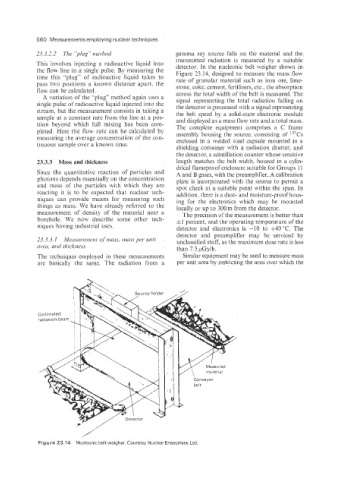
                                                     transmitted  radiation  is  measured  by  a  suitable
            This  involves injecting a  radioactive  liquid  into   detector.  In the nucleonic belt weigher shown in
            the flow  line in a single pulse. By  measuring the   Figure 23.14, designed to measure the mass flow
            time  this  “plug”  of  radioactive  liquid  takes  to
            pass  two  positions  a  known  distance  apart, the   rate  of  granular material  such as iron ore, lime-
                                                     stone, coke. cement, fertilizers, etc., the absorption
            flow can be calculated.                  across the total width of the belt is measured. The
              A variation  of  the “plug” method again uses a
            single pulse of radioactive liquid injected into the   signal representing the  total  radiation  falling on
                                                     the detector is processed with a signal representing
            stream, but the measurement consists in taking a   the belt speed by  a  solid-state electronic module
            sample at a constant rate from the line at a pos-   and displayed as a mass flow rate and a total mass.
            ition  beyond  which  full  mixing has  been  com-   The  complete  equipment  comprises  a  C  frame
            pleted.  Here  the  flow rate can  be calculated  by   assembly housing the  source. consisting of  137Cs
            measuring the average concentration of the con-   enclosed in  a welded  steel capsule mounted  in  a
            tinuous sample over a known time.
                                                     shielding container  with a  radiation  shutter, and
                                                     the detector, a scintillation counter whose sensitive
            23.3.3  Mass and thickness               length matches the belt width, housed in a cylin-
                                                     drical flameproof enclosure suitable for Groups 11
            Since the  quantitative  reaction  of  particles  and   A and B gases, with the preamplifier. A calibration
            photons depends essentially on the concentration   plate is incorporated  with the source to permit a
            and  mass  of  the  particles  with  which  they  are   spot check at a suitable point within the span. In
            reacting  it  is  to  be  expected  that  nuclear  tech-   addition, there is a dust- and moisture-proof hous-
            niques  can  provide  means  for  measuring  such   ing  for  the  electronics which  may  be  mounted
            things as mass. We have already referred to the   locally or up to 300 m from the detector.
            measurement  of  density  of  the  material  near  a   The precision of the measurement is better than
            borehole.  We  now  describe  some  other  tech-   *I  percent, and the operating temperature of the
            niques having industrial uses.            detector  and  electronics is  -10  to  +40”C. The
                                                      detector  and  preamplifier  may  be  serviced  by
            23.3.3. I   Measzrwnerit of niass, mass per ziiiit   unclassified staff, as the maximum dose rate is less
            clrecr, aid thickness                     than 7.5 pGyIh.
            The  techniques employed in these measurements   Similar equipment may be used to measure mass
            are  basically  the  same.  The  radiation  from  a   per unit area by restricting the area over which the


             radiation  beam
             radiation beam


                          /
             Figure 23.14  Nucleonic belt weigher. Courtesy Nuclear Enterprises Ltd.

