


Page 573 - Instrumentation Reference Book 3E
P. 573
Materials analysis  555


                                                      1.0  -


           t.


                                                            0.5   1.0   1.5   2.0   2.5   3.0
                                                                   Soil density  (g/crn3)

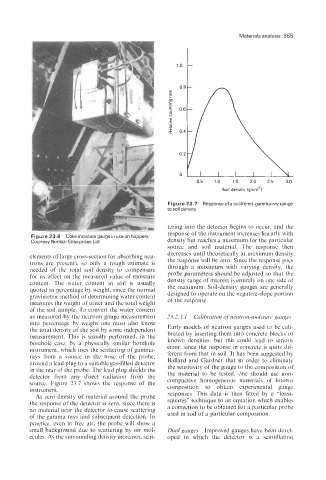
                                                   Figure 23.7  Response  of a scattered-gamma-ray gauge
                                                   to soil densitv.

                                                   tering into the detector begins to occur, and the
                                                   response of the instrument increases linearly with
          Figure 23.6  Coke moisture gauge in use on hoppers   density but reaches a maximum for the particular
          Courtesy Nuclear Enterprises Ltd.
                                                   source  and  soil  material.  The  response  then
                                                   decreases  until theoretically at maximum density
          elements of large cross-section for absorbing neu-   the response will be zero. Since the response goes
          trons  are present),  so  only  a  rough  estimate  is   through  a  maximum  with  varying  density,  the
          needed  of  the  total  soil  density  to  compensate
          for its effect  on the measured value  of moisture   probe parameters should be adjusted so that the
                                                   density range of interest is entirely on one side of
          content.  The  water  content  in  soil  is  usually   the maximum.  Soil-density  gauges are generally
          quoted as percentage by weight, since the normal
          gravimetric method of determining water content   designed to operate on the negative-slope portion
          measures the weight of water and the total weight   of the response.
          of the soil sample. To convert the water content
          as measured by  the neutron gauge measurement   23.2.3.1  Calibration of neutron-moistlire gauges
          into percentage  by  weight  one must  also  know
          the total density of the soil by some independent   Early models of  neutron  gauges used  to be cali-
          measurement.  This  is  usually  performed,  in  the   brated by  inserting them into concrete blocks of
          borehole case,  by  a  physically  similar  borehole   known  densities,  but  this  could  lead  to  serious
          instrument, which  uses the scattering of gamma-   error, since the response in concrete is quite dif-
          rays  from  a  source  in  the  nose  of  the  probe,   ferent from that in soil. It has been suggested by
          around a lead plug to a suitable gas-filled detector   Ballard  and Gardner that  in  order  to eliminate
                                                   the sensitivity of the gauge to the composition of
          in the rear of the probe. The lead plug shields the
          detector  from  any  direct  radiation  from  the   the material  to  be  tested,  one should  use  non-
                                                   compactive  homogeneous  materials  of  known
          source.  Figure  23.7  shows  the  response  of  the
          instrument.                              composition  to  obtain  experimental  gauge
                                                   responses.  This  data  is  then  fitted  by  a  “least-
            At zero  density of  material  around the probe
          the response of the detector is zero, since there is   squares” technique to an equation which enables
                                                   a correction to be obtained for a particular probe
          no material near the detector to cause scattering   used in soil of a particular composition.
          of the gamma rays and subsequent detection. In
          practice,  even  in  free air, the probe will  show a
          small  background  due to scattering by  air mol-   Dual guuges  Improved gauges have been devel-
          ecules. As the surrounding density increases, scat-   oped  in  which  the  detector  is  a  scintillation

