


Page 568 - Instrumentation Reference Book 3E
P. 568
550  Measurements employing nuclear techniques

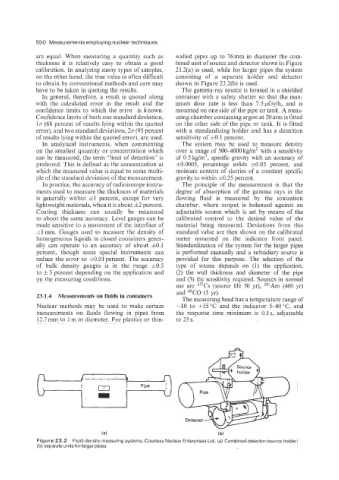
            are  equal.  When  measuring  a  quantity such  as   walled  pipes up to  76mm in diameter  the com-
            thickness  it  is  relatively  easy  to  obtain  a  good   bined unit of source and detector shown in Figure
            calibration. In analyzing many types of samples,   23.2(a) is used, while for larger pipes the system
            on the other hand, the true value is often difficult   consisting  of  a  separate  holder  and  detector
            to obtain by conventional methods and care may   shown in Figure 23.2(b) is used.
            have to be taken in quoting the results.   The gamma-ray source is housed in a shielded
              In general. therefore,  a result  is quoted along   container with a safety shutter  so that the max-
            with  the  calculated  error  in  the  result  and  the   imum  dose  rate  is  less  than  7.5pGy/h,  and  is
            confidence limits to which the error  is known.   mounted on one side of the pipe or tank. A meas-
            Confidence limits of both one standard deviation,   uring chamber containing argon at 20 atm is fitted
            la (68 percent of results lying within the quoted   on the other side of the pipe or tank. It is fitted
            error), and two standard deviations, 2a (95 percent   with  a standardizing holder  and has a detection
            of results lying within the quoted error), are used.   sensitivity of kO.1 percent.
              In  analytical  instruments,  when  commenting   The  system may  be  used  to  measure  density
            on the smallest quantity or concentration  which   over a  ran  e of 5004000 kg/m2 with a sensitivity
                                                             5
            can be measured, the term “limit of detection” is   of  0.5 kg/m . specific gravity with  an accuracy of
            preferred. This is defined as the concentration  at   f0.0005,  percentage  solids  &0.05  percent,  and
            which the measured value is equal to some multi-   moisture content of  slurries of  a constant  specific
            ple of the standard deviation of the measurement.   gravity to within h0.25 percent.
              In practice, the accuracy of radioisotope instru-   The  principle  of  the measurement  is  that  the
            ments used to measure the thickness of materials   degree of  absorption  of  the gamma  rays  in  the
            is  generally  within  *I  percent,  except  for  very   flowing  fluid  is  measured  by  the  ionization
            lightweight materials, when it is about 1t2 percent.   chamber,  where  output  is  balanced  against  an
            Coating  thickness  can  usually  be  measured   adjustable  source  which  is  set  by  means  of  the
            to about the same accuracy. Level gauges can be   calibrated  control  to  the  desired  value  of  the
            made sensitive to a movement of the interface of   material  being  measured.  Deviations  from  this
            klmm. Gauges used  to measure  the density  of   standard value are then shown on the calibrated
            homogeneous liquids in closed containers gener-   meter  mounted  on  the  indicator  front  panel.
            ally  can  operate  to  an  accuracy  of  about  hO.l   Standardization of  the system for the larger pipes
            percent,  though  some  special  instruments  can   is performed manually and a  subsidiary source is
            reduce the error to  kO.01 percent.  The accuracy   provided  for  this  purpose.  The  selection of  the
            of  bulk  density  gauges  is  in  the  range  3~0.5  type  of  source  depends  on  (1)  the  application,
            to f 5 percent depending on the application and   (2)  the  wall  thickness  and  diameter  of  the  pipe
            on the measuring conditions.             and (3) the sensitivity required. Sources in normal
                                                     use  are  137Cs (source life  30  yr),  241Am (460  yr)
                                                     and 6oC0 (5 yr).
            23.1.4  Measurements on fluids in containers
                                                       The measuring head has a temperature range of
            Nuclear  methods  may  be  used  to  make  certain   -10  to  +55”C  and  the  indicator  540”C, and
            measurements  on  fluids  flowing  in  pipes  from   the  response  time  minimum  is  0.1 s,  adjustable
            11.7mm to 1 m in diameter. For plastics or thin-   to 25 s.


                               (a)
            Figure 23.2  Fluid-density measuring systems. Courtesy Nuclear Enterprises Ltd. (a) Combined detector/source holder;
            (b) separate units for larger pipes.

