


Page 569 - Instrumentation Reference Book 3E
P. 569
Materials analysis 551

            23.2!  Materials analysis                 radiation emitted as the excited atoms of the elem-
                                                      ent of interest decay with emission of gamma rays
            Nuclear methods of analysis, particularly neutron   or  beta  particles,  while  not  responding  to  other
             activation  analysis,  offer  the  most  sensitive   types  of  radiation  or  to  different  energies from
            methods  available  for  most  elements  in  nature.   other elements which may be present in the sample.
             However, no one method is suitable for all elements,   The decay half-life of the radiation is also used to
             and it is necessary to select the techniques to be used   identify the  element  of  interest, while  the  actual
            with  due  regard  to  the  various  factors  involved,   magnitude of the response at the particular energy
             some of which may be listed as follows:   involved is a direct measure of the amount of the
                                                      element of interest in the sample. Quantitatively the
             (1)  Element to be detected:             basic relation between A, the induced activity pres-
             (2)  Quantities involved;                ent at the end of the irradiation in Becquerels, iie.,
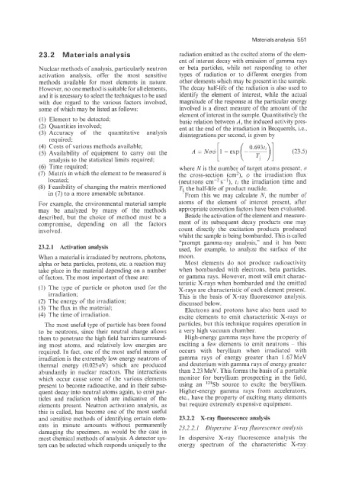
             (3)  Accuracy  of  the  quantitative  analysis   disintegrations per second, is given by
               required;
             (4)  Costs of various methods available;
             (5)  A.vailability  of  equipment  to  carry  out  the
                a:nalysis to the statistical limits required;
             (6)  Time required;                      where N is the number of target atoms present, 0
             (7)  Matrix in which the element to be measured is   the  cross-section  (cm’),  @  the  irradiation  flux
               located;                               (neutrons  cm-’  s-l),  ti  the irradiation  time  and
             (8)  Feasibility of changing the matrix mentioned   Ti the half-life of product nuclide.
                irn  (7) to a more amenable substance.   -From this we  may  calculate N, the number  of
             For example, the environmental material sample   atoms  of  the  element  of  interest  present,  after
             may  be  analyzed  by  many  of  the  methods   appropriate correction factors have been evaluated.
             described,  but  the choice  of  method  must  be  a   Beside the activation of the element and measure-
             compromise,  depending  on  all  the  factors   ment  of  its  subsequent decay  products  one  may
             involved.                                count  directly  the  excitation  products  produced
                                                      whilst the sample is being bombarded. This is called
                                                      “prompt  gamma-ray  analysis,” and  it  has  been
             23.2.11  Activation analysis             used; for  example, to  analyze the  surface of  the
             When a material is irradiated by neutrons, photons,   moon.
             alpha or beta particles, protons, etc. a reaction may   Most  elements  do  not  produce  radioactivity
             take ]place in the material depending on a number   when  bombarded  with  electrons, beta  particles.
             of factors. The most important of these are:   or gamma rays. However, most will emit charac-
                                                      teristic X-rays when bombarded  and the emitted
             (1)  The  type  of  particle  or photon  used for the   X-rays are characteristic of each element present.
                irradiation:                          This is  the basis  of X-ray  fluorescence analysis.
             (2)  The energy of the irradiation;      discussed below.
             (3) The flux in the material;              Electrons and protons have also been used to
             (4)  The time of irradiation.            excite elements to emit  characteristic  X-rays  or
              The nost useful type of particle has been found   particles, but this technique requires operation in
             to  be  neutrons,  since their neutral  charge allows   a very high vacuum chamber,
             them to penetrate the high field barriers surround-   High-energy gamma rays have the property of
             ing  most  atoms;  and  relatively  low  energies are   exciting a  few elements to  emit  neutrons  - this
             required. In fact, one of the most useful means of   occurs  with  beryllium  when  irradiated  with
             irradiation is the extreimely low energy neutrons of   gamma  rays  of  energy  greater  than  1.67MeV
             thermal  energy  (0.025 eV)  which  are  produced   and deuterium with gamma rays of energy greater
             abundantly  in  nuclear  reactors.  The  interactions   than 2.23 MeV. This forms the basis of a portable
             which  occur cause some of  the  various elements   monitor  for  beryllium  prospecting  in  the  field,
             present to become radioactive, and in their subse-   using  an  ‘”Sb  source  to  excite  the  beryllium.
             quent decay into neutral atoms again, to emit par-   Higher-energy  gamma  rays  from  accelerators,
             ticles  and  radiation  which  are  indicative of  the   etc., have the property of exciting many elements
             elements present. Neutron  activation analysis, as   but require extremely expensive equipment.
             this is called, has become one of  the most useful
             and s,ensitive methods of identifying certain elem-   23.2.2  X-ray fluorescence analysis
             ents  in  minute  amounts  without  permanently   23.2.2.1  Dispersive  X-ray fluorescence analysis
             damaging the  specimen, as would  be  the case in
             most chemical methods of analysis. A detector sys-   In  dispersive  X-ray  fluorescence  analysis  the
             tem can be selected which responds uniquely to the   energy  spectrum  of  the  characteristic  X-ray

