


Page 574 - Instrumentation Reference Book 3E
P. 574
556  Measurements employing nuclear techniques

            counter  with  the  scintillator  of cerium-activated   changes  in  the  carbon-hydrogen  ratio  of  the
            lithium  glass. As  such a  detector  is  sensitive to   hydrocarbon.  When  the  X-rays  used  have  an
            both neutrons  and gamma rays, the same probe   energy of  22 keV  the  mass  attenuation for  car-
            may  be  used  to  detect  both  slowed-down  neu-   bon  and  hydrogen  are  equal.  Thus  by  using
            trons  and  gamma  rays  from  the  source-the   X-rays produced by  allowing the radiation from
            two can be distinguished because they give pulses   the radio-element  ’“Am  to produce  fluorescent
            of different  shapes. This avoids the necessity  of   excitation  in  a  silver target  which  gives X-rays
            having two probes, one to measure neutrons and   having  an  energy  of  23keV,  the  absorption  is
            the other to measure scattered gammas, allowing   made  independent  of  the  carbon-hydrogen
            the measurement of both moisture and density by   ratio.  As  this  source  has  a  half-life  of  450yr.
            pulse-shape analysis.                    no  drift  occurs  owing  to  decay  of  the  source.
              Surface-neutron  gauges  are  also  available.  in   The X-rays are passed through  a measuring cell
            which  both radioactive  source  and detector  are   through  which  the  hydrocarbon  flows  and,  as
            mounted  in  a  rectangular  box  which  is  simply   the absorption  per unit weight of sulfur is many
            placed  on a  flat  soil surface.  It  is  important to   times greater than the absorption  of carbon and
            provide  a smooth flat surface for such measure-   hydrogen, the fraction  of the X-rays absorbed is
            ments,  as  gaps  cause  appreciable  errors in  the   a  measure  of  the  concentration  of  the  sulfur
            response.                                 present.  Unfortunately  the degree of  absorption
                                                      of  X-rays  is  also  affected  by  the  density  of  the
            23.2.4  Measurement of sulfur contents of liquid   sample and by  the concentration  of  trace  elem-
                                                      ents  of  high  atomic weight  and of water.
            hydrocarbons
                                                       The concentration of X-rays is measured by a
            Sulfur occurs in many crude oils at a concentra-   high-resolution proportional counter so the accur-
            tion  of  up  to  5 percent  by  weight  and persists   acy will be a function of the statistical variation in
            to  a  lesser  extent  in  the  refined  product.  As   the  count rate  and  the  stability  of  the  detector
            legislation in many countries prohibits the burn-   and associated  electronics, which can  introduce
            ing  of  ftiels with  a  high  sulfur  content  to  min-   an error of &0.01 per cent sulfur. A water content
            imize pollution,  and sulfur  compounds  corrode   of  650ppm will  also introduce  an  error of  0.01
            engines  and  boilers  and  inhibit  catalysts,  it  is   percent  sulfur.  Compensation  for density varia-
            essential  to  reduce  the  concentration  to  toler-   tions may be achieved by  measuring the density
            able  levels.  Thus  rapid  measurement  of  sulfur   with  a  non-nucleonic  meter  and  electronically
            content is essential, and the measurement  of  the   correcting the sulfur signal.
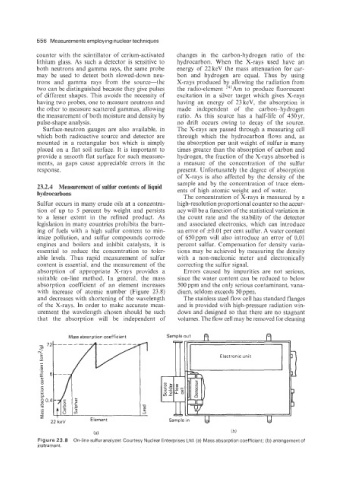
            absorption  of  appropriate  X-rays  provides  a   Errors  caused  by  impurities  are  not  serious,
            suitable  on-line  method.  In  general,  the  mass   since the water content can be reduced to below
            absorption  coefficient  of  an  element  increases   500 ppm and the only serious contaminant, vana-
            with  increase  of  atomic  number  (Figure  23.8)   dium. seldom exceeds 50 ppm.
            and decreases with shortening of the wavelength   The stainless steel flow cell has standard flanges
            of  the X-rays.  In order to make accurate meas-   and is provided with high-pressure radiation win-
            urement  the  wavelength  chosen  should  be  such   dows and designed so that there are no stagnant
            that  the  absorption  will  be  independent  of   volumes. The flow cell may be removed for cleaning


                      Mass absorption coefficient

             N
                                                                  Electronic unit


                22 keV      Element


            Figure 23.8  On-line sulfur analyzer. Courtesy Nuclear Enterprises Ltd. (a)  Mass absorption coefficient;  (b) arrangement of
            instrument.

