


Page 579 - Instrumentation Reference Book 3E
P. 579
Mechanical measurements 561

             radiation falls to a finite area; and if the thickness is
             constant and known the reading will be a measure
             of the density.
                                                       1 - p
                                                           Sl
                                                        ............
                                                        ..........
                                                        .........
                                                        ...........
                                                             .....
                                                         ........
             23.3.3.2  Measurement of coating thickness   ...........
                                                           1111
             In  industry  a  wide  variety  of  processes  occur
             where it  is  necessary to measure and sometimes
             automatically  control the  thickness of  a coating
             appkd to a base material produced in strip form.
             Examples of such processes are the deposition of
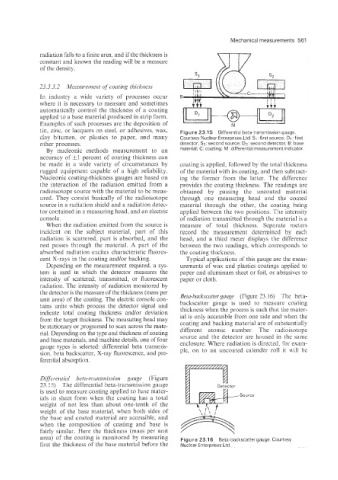
             tin, zinc:  or lacquers on steel, or adhesives, wax,   Figure 23.15  Differential beta-transmission gauge.
             clay  bitumen,  or  plastics  to  paper,  and  many   Courtesy Nuclear Enterprises Ltd. SI  :first source; D1 : first
             other processes.                         detector;  S2: second source; Dz: second detector; B: base
               By  nucleonic  methods  measurement  to  an   material; C: coating; M: differential measurement indicator.
             accuracy of  2~1 percent of  coating thickness can
             be  made  in  a  wide  variety  of  circumstances by   coating is applied, followed by the total thickness
             rugged  equipment  capable  of  a  high  reliability.   of the material with its coating, and then subtract-
             Nucleonic coating-thickness gauges are based on   ing  the  former  from  the  latter.  The  difference
             the  interaction  of  the  radiation  emitted  from  a   provides the coating thickness. The readings are
             radioisotope source with the material to be meas-   obtained  by  passing  the  uncoated  material
             ured.  They consist basically of the radioisotope   through  one  measuring  head  and  the  coated
             source in a radiation shield and a radiation detec-   material  through  the  other,  the  coating  being
             tor contained in a measuring head, and an electric   applied between the two positions. The intensity
             console.                                 of radiation transmitted through the material is a
               When the radiation emitted from the source is   measure  of  total  thickness.  Separate  meters
             incidlent  on  the  subject  material,  part  of  this   record  the  measurement  determined  by  each
             radiation  is  scattered, part  is  absorbed, and  the   head,  and  a  third  meter  displays the  difference
             rest  lmsses through  the  material.  A  part  of  the   between the two readings, which corresponds  to
             absorbed  radiation excites characteristic fluores-   the coating thickness.
             cent X-rays in the coating andlor backing.   Typical applications of this gauge are the meas-
               Depending on the measurement required, a sys-   urements of wax and plastics coatings applied to
             tem  is  used  in  which  the  detector measures  the   paper and aluminum sheet or foil, or abrasives to
             intensity of  scattered,  transmitted, or  fluorescent   paper or cloth.
             radiation. The intensity  of  radiation monitored by
             the detector is the measure of the thickness (mass per   Betu-backscatter gauge  (Figure 23.16)  The  beta-
             unit area) of  the coating. The electric console con-
             tains units  which  prolcess  the  detector signal  and   backscatter  gauge  is  used  to  measure  coating
             indicate  total  coating  thickness andlor  deviation   thickness when the process is such that the mater-
                                                      ial is only accessible from one side and when the
             from the target thickness. The measuring head may   coating and backing material are of substantially
             be stationary or programed to scan across the mate-   different  atomic  number.  The  radioisotope
             rial. Depending on the type and thickness of coating   source and  the detector  are housed  in  the same
             and base materials, and machine details, one of four
             gauge types  is  selected:  differential  beta  transmis-   enclosure. Where radiation is directed, for exam-
             sion, beta backscatter, X-ray fluorescence, and pre-   ple,  on  to  an  uncoated  calender  roll  it  will  be
             ferential absorption.

             Differential  beta-transmission  gauge  (Figure
             23.15)  The differential beta-transmission gauge
             is used to measure coating applied to base mater-
             ials in  sheet form when  the coating has  a  total        Source
             weight  of  not  less  than  about  one-tenth  of  the
             weiglht  of  the base material.  when  both  sides of
             the base and coated material  are accessible, and
             when  the  composition  of  coating  and  base  is
             fairly similar. Here the  thickness (mass per unit
             area) of  the coating is  monitored  by measuring   Figure 23.1 6  Beta-backscatter gauge. Courtesy
             first the thickness of the base material before the   Nuclear Enterprises Ltd.

