


Page 589 - Instrumentation Reference Book 3E
P. 589
Surface-inspection methods  571
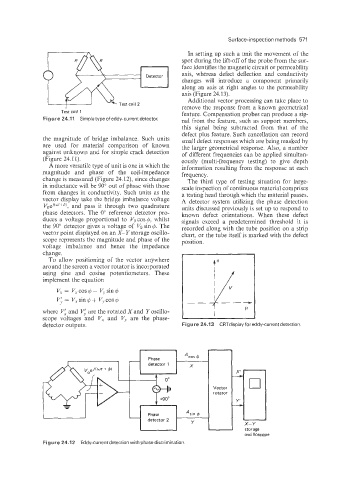
                                                         In setting up such a unit the movement of the
                                                       spot during the lift-off of the probe from the sur-
                                                       face identifies the magnetic circuit or permeability
                                                       axis,  whereas  defect  deflection  and  conductivity
                                                       changes  will  introduce  a  component  primarily
                                                       along an  axis  at riglit angles to the permeability
                                                       axis (Figure 24.13).
                                                         Additional vector processing can take place to
                                                       remove the response from a known  geometrical
                   Te'st coil 1                        feature. Compensation probes can produce a sig-
              Figure 24.17  Simple type of eddy-current detector.   nal from the feature,  such as support members,
                                                       this  signal  being  subtracted  from  that  of  the
                                                       defect plus feature. Such cancellation can record
              the  magnitude  of  bridge  imbalance.  Such  units   small defect responses which are being masked by
              are  used  for  material  comparison  of  known   the larger geometrical response. Also, a number
              against unknown and for simple crack detection   of different frequencies can be applied simultan-
              (Figure 24.11).                          eously  (multi-frequency  testing)  to  give  depth
                A imore versatile type of unit is one in which the   information  resulting from the response at each
              magnitude  and  phase  of  the  coil-impedance   frequency.
              change is measured (Figure 24.12), since changes   The  third  type  of  testing  situation  for  large-
              in inductance will be 90" out of phase with those   scale inspection of continuous material comprises
              from changes in conductivity.  Such units  as the   a testing head through which the material passes.
              vector display take the bridge imbalance voltage   A  detector  system utilizing the  phase  detection
              Voei(w'+d), and  pass  it  through  two  quadrature   units discussed previously is set up to respond to
              phas'e detectors.  The 0" reference  detector  pro-   known  defect  orientations.  When  these  defect
              duces a  voltage proportional  to  Vo cos @,  whilst   signals  exceed  a  predetermined  threshold  it  is
              the 90" detector  gives a voltage of  Vo sin 4. The   recorded along with the tube position on a strip
              vector point displayed on an X-Ystorage  oscillo-   chart, or the tube itself is marked with the defect
              scope represents the magnitude and phase of the   position.
              voltaige  imbalance  and  hence  the  impedance
              change.
                To  allow positioning  of  the  vector  anywhere
              around the screen a vector rotator is incorporated
              using  sine  and  cosine  potentiometers.  These
              implement the equation
                  V.. = V,cos@ - V,sind
                  y, = V, sin 4 + V, cos 4
              where VL and Vl are the rotated X and Y oscillo-
              scope  voltages  and  V,  and  V,  are  the  phase-
              detector outputs.                        Figure 24.13  CRTdisplay for eddy-current detection.


                                                                          oscilloscope
              Figure 24.12  Eddy-current detection with phase discrimination.

