


Page 593 - Instrumentation Reference Book 3E
P. 593
Ultrasonics  575


                                            (b)
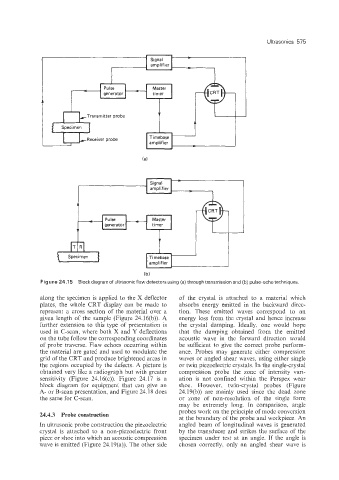
             Figure 24.1 5  Block diagram of ultrasonic flaw detectors using (a) through transmission and (b) pulse-echo techniques.
             along the specimen is applied to the X deflector   of  the  crystal  is  attached  to  a  material  which
             plates,  the  whole  CRT display can  be  made  to   absorbs  energy  emitted  in  the  backward  direc-
             represent  a  cross section of  the  material  over a   tion.  These  emitted  waves  correspond  to  an
             given  length  of  the  sample (Figure  24.16(b)). A   energy loss from the  crystal and hence increase
             further  extension to this type  of  presentation  is   the  crystal  damping.  Ideally,  one  would  hope
             used in C-scan, where both X and Y deflections   that  the  damping  obtained  from  the  emitted
             on the tube follow the corresponding coordinates   acoustic  wave  in  the  forward  direction  would
             of prlobe traverse. Flaw echoes occurring within   be  sufficient to give  the correct  probe  perform-
             the material are gated  and used to modulate the   ance.  Probes  may  generate  either  compression
             grid of the CRT and produce brightened areas in   waves or angled shear waves, using either single
             the regions occupied 'by the defects. A picture is   or twin piezoelectric crystals. In the single-crystal
             obtained very like a radiograph but with greater   compression  probe  the  zone  of  intensity  vari-
             sensitivity  (Figure  24.16(c)).  Figure  24.17  is  a   ation  is  not  confined  within  the  Perspex  wear
             block  diagram  for  equipment  that  can  give  an   shoe.  However,  twin-crystal  probes  (Figure
             A- or B-scan presentation, and Figure 24.18 does   24.19(b))  are  mainly  used  since  the  dead  zone
             the same for C-scan.                     or  zone  of  non-resolution  of  the  single  form
                                                      may  be  extremely  long.  In  comparison,  angle
                                                      probes work on the principle of mode conversion
             24.4.3  Probe construction
                                                      at the boundary of the probe and workpiece. An
             In ultrasonic probe construction the piezoelectric   angled beam  of  longitudinal  waves is  generated
             crystal  is  attached  to  a  non-piezoelectric  front   by  the transducer  and strikes the  surface of  the
             piece or shoe into which an acoustic compression   specimen under  test  at an angle. If  the  angle is
             wave is emitted (Figure 24.19(a)). The other side   chosen  correctly,  only  an  angled  shear  wave  is

