


Page 596 - Instrumentation Reference Book 3E
P. 596
578  Non-destructive testing

                                Connector

                                                           xConnector
                                            Absorber


                 1   Perspex shoe   I    co


                                                 ,/  Shear
                  Compression probe             I
                                                 Shear probe


                                                             Transmitter
                                                             crystal
                                                Absorber     /


                                                            Receiver
                         t                                  crystal
                         Cork shin
                     Compression probe        Shear probe: pian view
                                        (b)
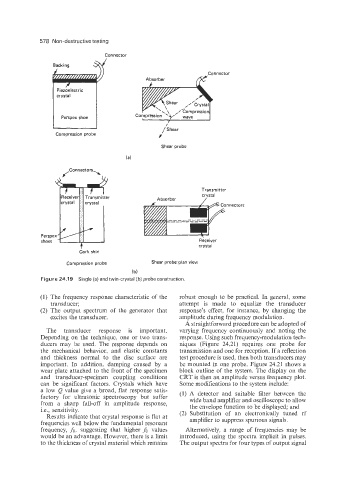
             Figure 24.19  Single (a)  and twin-crystal  (b) probe construction.

             (1)  The frequency response characteristic  of  the   robust  enough to be  practical.  In  general, some
                transducer;                           attempt  is  made  to  equalize  the  transducer
             (2)  The  output  spectrum  of  the  generator  that   response’s  effect, for  instance,  by  changing  the
                excites the transducer.               amplitude during frequency modulation.
                                                        A straightforward procedure can be adopted of
               The  transducer  response  is  important.   varying  frequency continuously  and  noting  the
             Depending  on  the technique,  one or two  trans-   response. Using such frequency-modulation tech-
             ducers  may  be  used.  The response  depends  on   niques  (Figure  24.21)  requires  one  probe  for
             the  mechanical  behavior,  and  elastic  constants   transmission and one for reception. If a reflection
             and  thickness  normal  to  the  disc  surface  are   test procedure is used, then both transducers may
             important.  In  addition,  damping  caused  by  a   be mounted in one probe.  Figure 24.21  shows a
             wear plate  attached to the front of the specimen   block  outline  of the system. The display on the
             and  transducer-specimen  coupling  conditions   CRT is then an amplitude versus frequency plot.
             can  be  significant factors.  Crystals  which  have   Some modifications to the system include:
             a low  Q value give a broad,  flat  response satis-
             factory  for  ultrasonic  spectroscopy  but  suffer   (1) A  detector  and  suitable  filter  between  the
             from  a  sharp  fall-off  in  amplitude  response,   wide band amplifier and oscilloscope to allow
                                                         the envelope function to be displayed; and
             i.e.,  sensitivity.
               Results indicate that crystal response is flat at   (2)  Substitution  of  an  electronically  tuned  rf
             frequencies well below the fundamental resonant   amplifier to suppress spurious signals.
             frequency, fo,  suggesting that  higher fo  values   Alternatively,  a  range  of  frequencies may  be
             would be an advantage. However, there is a limit   introduced, using the  spectra  implicit in  pulses.
             to the thickness of crystal material which remains   The output spectra for four types of output signal

