


Page 595 - Instrumentation Reference Book 3E
P. 595
Ultrasonics  577

                                     Scanning frame


                                         T
                                             Specimen


            voltages  II                                 I   Flaw-detector unit
            X  and Y
            indexing
             probe
             positiorl


                                                         tracking unit  I   Selector


                                                      Pen dropping signal
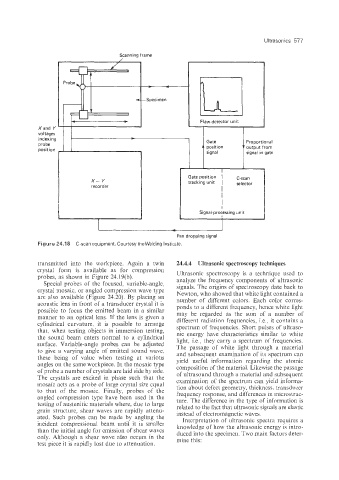
            Figure! 24.18  C-scan equipment. Courtesy thewelding Institute.

            transmitted  into  the  workpiece.  Again  a  twin   24.4.4  Ultrasonic spectroscopy techniques
            crystal.  form  is  available  as  for  compression   Ultrasonic  spectroscopy  is  a  technique  used  to
            probes, as shown in Figure 24.19(b).     analyze the frequency components of  ultrasonic
              Special probes  of  the  focused, variable-angle,
                                                      signals. The origins of spectroscopy date back to
            crystall mosaic: or angled compression wave type   Newton, who showed that white light contained a
            are also  available (Figure 24.20). By  placing  an   number  of  different  colors.  Each  color  corres-
            acoustic lens in front of a transducer crystal it is   ponds to a different frequency, hence white light
            possible  to focus  the  emitted  beam  in  a  similar   may  be  regarded  as  the  sum  of  a  number  of
            manner  to an optical lens. If the lens is given a   different radiation  frequencies, Le., it contains a
            cylindrical  curvature,  it  is  possible  to  arrange   spectrum of frequencies. Short pulses of ultraso-
            that,  when  testing  objects in  immersion  testing,   nic  energy have  characteristics  similar  to  white
            the  sound  beam  enters  normal  to  a  cylindrical   light, i.e., they  carry  a  spectrum  of frequencies.
            surface.  Variable-angle  probes  can  be  adjusted   The  passage  of  white  light  through  a  material
            to  give  a varying  angle of  emitted  sound  wave,   and subsequent examination of  its spectrum can
            these  being  of  value  when  testing  at  various   yield  useful  information  regarding  the  atomic
            angles on the same workpiece. In the mosaic type   composition of the material. Likewise the passage
            of probe a number of crystals are laid side by side.   of ultrasound through a material and subsequent
            The  crystals  are excited in  phase  such  that  the
            mosaic acts as a probe of large crystal size equal   examination of  the spectrum can yield  informa-
            to  that  of  the  mosaic.  Finally,  probes  of  the   tion about defect geometry, thickness, transducer
                                                     frequency response, and differences in microstruc-
            angled  compression  type  have  been  used  in  the   ture. The difference in the type of  information  is
            testing of austenitic materials where, due to large   related to the fact that ultrasonic signals are elastic
            grain  structure,  shear  waves  are rapidly  attenu-   instead of electromagnetic waves.
            ated.  Such probes  can  be  made  by  angling  the   Interpretation  of  ultrasonic  spectra requires  a
            incident  compressional  beam  until  it  is  smaller   knowledge of how the ultrasonic energy is intro-
            than the initial angle for emission of shear waves   duced into the specimen. Two main factors deter-
            only.  Although  a  shear  wave  also  occurs in  the   mine this:
            test piece it is rapidly lost due to attenuation.

