


Page 598 - Instrumentation Reference Book 3E
P. 598
580  Non-destructive testing

                       Synchronization
              Pulse
              generator
            i
                                                          Oscilloscope
                                                      Y

                                Wide-band              2
                                amplifier   .   1

                  Transducer                                  1
               Eia                                     Spectrum
              Specimen                                 analyzer

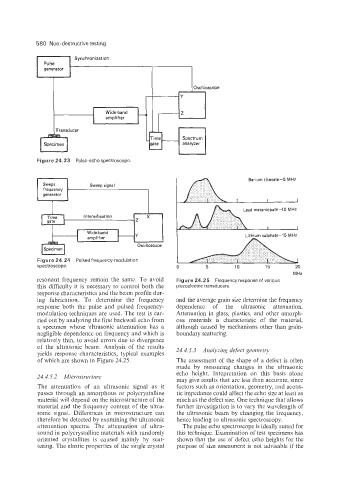
            Figure 24.23  Pulse-echo spectroscope.


                                                                           Barium titanate-5  MHz
              Swept         Sweep signal
              frequency
              generator
                                                 -                       Lead metanlobate-10  MHZ
                          intensification    X
                                         2
                                         Y           I                    Lithium sul~hate-15 MHZ
                                          Osci I loscope
              Specimen
            Figure 24.24  Pulsedfrequency-modulation
            spectroscope.
                                                                                        M Hz
            resonant  frequency  remain  the  same.  To  avoid   Figure 24.25   Frequencyresponseof various
            this difficulty it is necessary to control both the   piezoelectric transducers.
            response characteristics and the beam profile dur-
            ing  fabrication.  To  determine  the  frequency   and the average grain size determine the frequency
            response  both  the  pulse  and  pulsed  frequency-   dependence  of   the  ultrasonic  attenuation.
            modulation  techniques are used. The test is car-   Attenuation  in glass, plastics, and  other amorph-
            ried out by analyzing the first backwall echo from   ous  materials  is  characteristic  of  the  material,
            a  specimen whose  ultrasonic  attenuation has  a   although caused by mechanisms other than grain-
            negligible dependence on frequency and which is   boundary scattering.
            relatively thin, to avoid errors due to divergence
            of  the  ultrasonic  beam.  Analysis  of  the  results   24.4.5.3  Analyzing defect geometry
            yields  response  characteristics,  typical  examples
            of which are shown in Figure 24.25.       The assessment of  the shape of a defect is often
                                                     made  by  measuring  changes  in  the  ultrasonic
                                                      echo  height.  Intepretation  on  this  basis  alone
            24.4.5.2  Microstructure
                                                      may give results that are less than accurate, since
            The  attenuation  of  an  ultrasonic  signal  as  it   factors such as orientation, geometry, and acous-
            passes through an amorphous or polycrystalline   tic impedance could affect the echo size at least as
            material will depend on the microstructure of the   much as the defect size. One technique that allows
            material and the frequency content  of the ultra-   further investigation is to vary the wavelength of
            sonic  signal.  Differences  in  microstructure  can   the ultrasonic beam by  changing the frequency,
            therefore be detected by examining the ultrasonic   hence leading to ultrasonic spectroscopy.
            attenuation  spectra.  The  attenuation  of  ultra-   The pulse echo spectroscope is ideally suited for
            sound in polycrystalline materials with randomly   this technique. Examination of test specimens has
            oriented  crystallites  is  caused  mainly  by  scat-   shown that the use of defect echo heights for the
            tering. The elastic properties of the single crystal   purpose of  size assessment is not advisable if the

