


Page 599 - Instrumentation Reference Book 3E
P. 599
Ultrasonics  581

             spectral  “signatures”  of  the  defect  echoes  show   photoelastic  stress analysis (see Chapter  4, Sec-
             significant differences.                 tion  4.9).  Visualization  works  well  in  situations
                                                      where continuous ultrasound  is being used. If a
                                                      pulsed system is used then collimation of the light
             24.4.6  Other ways of presenting information
             from ultrasonics                         beam crossing the ultrasound beam and a pulsed
                                                      light source are required.
             Many  other  techniques  of  processing  ultrasonic   The principal advantage of a photoelastic  sys-
             infomation are available, and in the following the   tem  is  its  compactness  and  lack  of  protective
             gener,al principles of two main groups: (1) ultrason-   covering in contrast to the Schlieren system.
             ic  visualization  or  (2)  ultrasonic imaging will  be   Photoelastic  systems  are  also  cheaper.  How-
             outlined. More detailed information may be found   ever, the Schlieren system’s major advantage lies
             in the references given at the end of this chapter.   in  its  ability  to  visualize in  fluids  as well  as in
               Ultrasonic visualization makes use of two main   solids. The sensitivity of  photoelastic techniques
             techniques: (I) Schlieren methods and (2) photo-   to longitudinal waves is half that for shear waves.
             elastic methods. A third method combining both   Measurements  with  Schlieren  systems  have
             of  these has  been described by  D. M. Marsh in   shown that the sensitivity of ultrasound visualiza-
             Research  Techniques in  hTon-destructive  Testing   tion systems is particularly  affected by misalign-
             (1973).  Schlieren methods  depend  on  detecting   ment of the beam. For example, misalignment of
             the deviation  of  light caused by  refractive index   the beam  in  water  is magnified by  refraction  in
             gradients  accompanying  ultrasonic  waves.  In   the solid. It is therefore  essential to ensure firm
             most cases this technique has been used in liquids.   securing of transducers by clamps capable of fine
             Photoelastic  visualization  reveals the  stresses in   adjustment.
             an  ultrasonic  wave  using  crossed  Polaroids  to   An  alternative  approach  to  visualization  of
             detect  stress birefringence of  the medium. Main   ultrasonic  waves is  the  formation  of  an  optical
             uses have been for particularly intense fields, such   image from ultrasonic  radiation.  Many  systems
             as  those  in  solids in  physical  contact  with  the   exist in this field and, once again, a few selected
             transducer. Many other methods have been tried.   systems will be outlined.
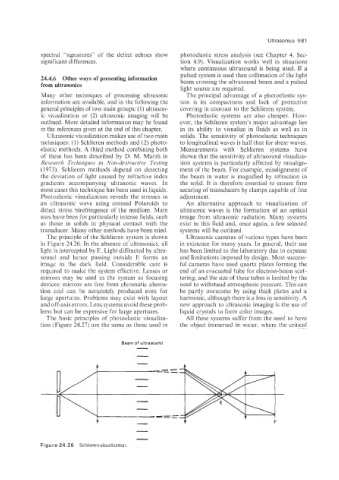
               The principle of the Schlieren system is shown   Ultrasonic cameras of various types have been
             in Figure 24.26. In the absence of ultrasonics. all   in existence for many years. In general, their use
             light is intercepted by E. Light diffracted by ultra-   has been limited to the laboratory due to expense
             sound  and  hence  passing  outside  E  forms  an   and limitations imposed by design. Most success-
             image  in  the  dark  field.  Considerable  care  is   ful cameras have used quartz plates forming the
             required  to make the system effective. Lenses or   end of an evacuated tube for electron-beam scat-
             mirrors  may  be  used  in  the  system as  focusing   tering, and the size of these tubes is limited by the
             devices; mirrors  are free from chromatic aberra-   need to withstand atmospheric pressure. This can
             tion  and  can  be  accurately  produced  even  for   be  partly  overcome by  using  thick  plates  and a
             large apertures. Problems may exist with layout   harmonic, although there is a loss in sensitivity. A
             and off-axis errors. Lens systems avoid these prob-   new approach to ultrasonic imaging is the use of
             lems but can be expensive for large apertures.   liquid crystals to form color images.
               The  basic principles of photoelastic visualiza-   All these systems suffer from the need to have
             tion ((Figure  24.27) are the same as those used in   the object immersed in water.  where the critical

                                          -
                                     Beam of ultrasound
                                          -


                                          -

             Figure 24.26 Schlieren visualization.

