


Page 604 - Instrumentation Reference Book 3E
P. 604
586  Non-destructive testing

            Table 24.2  Maximum thickness of steel which can be   X-ray tube
            radiographed with different X-ray energies
            X-ray ene~gy   High-sensitivity   Low-sensitivity
            (keV)s       technique      tech ique
                         thickness (mm)   thickness (mm)
             100          IO            25
             150          15            50
             200          25            75
             250          40            90
             400          75            110
            1000         125            160
            2 000        200            250                                    1
            5 000        300            3 50                 0         rv
            30 000       300            380            w
                                                                    Tube voltage

                                                                    Tube current
            24.5.3.1  Wire type of IQI                              Transformer voltage
            This consists of a  series of straight wires 30mm     (a)
            long and diameters as shown in Table 24.3.  Five
            models  are  available,  the  most  popular  con-
            taining seven consecutive wires. The wires are laid
            parallel  and  equidistant  from  each  other  and    n
            mounted  between  two  thin  transparent  plastic
            sheets of low absorption  for X- or gamma rays.
            This means that  although the wires are fixed in
            relation to each other, the IQI is flexible and thus                 -V
            useful for curved specimens. The wires should be
            of the same material as that being radiographed.
            IQIs  for  steel, copper,  and  aluminum  are com-
            mercially  available.  For  other  materials  it  may
            not  be  possible  to  obtain  an  IQI  of  matching
            composition.  In  this  case, a  material  of  similar   *:p
            absorptive properties may be substituted.
              Also enclosed in the plastic sheet are letters and     Tube voltage
            numbers  to  indicate  the  material  type  and  the     Transformer  voltage
            series  of  wires  (Figure  24.33).  For  example,
            4Fe10 indicates that the IQI is suitable for iron   -V
            and steel and contains wire diameters from 0.063
            to 0.25 mm.
              For weld  radiography, the  IQI is placed with        Ib)
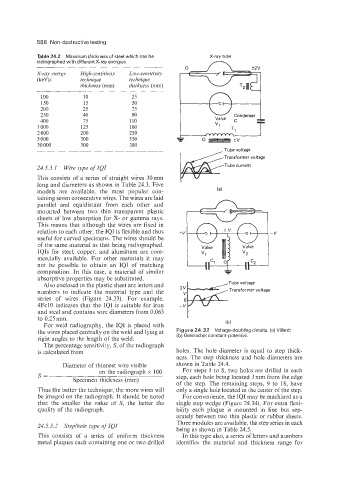
            the wires placed centrally on the weld and lying at   Figure 24.32  Voltage-doubling circuits. (a) Villard:
            right angles to the length of the weld.   (b) Greinacher constant-potential.
              The percentage sensitivity, S, of the radiograph
            is calculated from                        holes. The hole  diameter  is equal  to step thick-
                                                      ness. The step thickness and hole diameters are
                    Diameter of thinnest wire visible   shown in Table 24.4.
                              on the radiograph x  100   For steps 1  to 8, two holes are drilled in each
            S=                                        step, each hole being located 3 mm from the edge
                       Specimen thickness (mm)
                                                      of  the  step. The remaining  steps, 9  to  lS,  have
            Thus the better the technique, the more wires will   only a single hole located in the center of the step.
            be imaged on the radiograph. It should be noted   For convenience, the IQI may be machined as a
            that  the  smaller  the  value  of  S, the  better  the   single step wedge (Figure 24.34). For extra flexi-
            quality of the radiograph.                bility  each  plaque  is  mounted  in  line  but  sep-
                                                      arately between  two thin plastic or rubber sheets.
                                                      Three modules are available, the step series in each
            24.5.3.2  Steplhole type of IQI
                                                      being as shown in Table 24.5.
            This  consists  of  a  series  of  uniform  thickness   In this type also, a series of letters and numbers
            metal plaques each containing one or two drilled   identifies  the  material  and  thickness  range  for

