


Page 606 - Instrumentation Reference Book 3E
P. 606
588 Non-destructive testing
                       I                                  mixture  which,  although  increasing  bright-
                        - - - - - - - - - - - - - - __
                                                          ness,  gives  a  coarser-grained  and  hence  a
                   Charge
                   level                Charged plate     more blurred image.
                                        before exposure
                       I                               (3)  The image produced on a fluoroscopic screen
                         Distance across plate            is much  less contrasty than that on a radio-
                        f fi 4   f f  f +  .)flncident  radiation   graph.
                           f
                                                       24.5.5.1  Image-intensification system
                                                       In  fluoroscopy  the main  problem  of  low screen
                                                       brightness is due mainly to:
                         Distance across Dlate
                                                       (1)  The  low  efficiency-only   a  fraction  of  the
              Thickness of                                incident X-rays are converted into light.
              powder deposit            Developed plate   (2)  The light which is produced  at the screen is
                                                          scattered in all directions, so that only a small
                         Distance across plate            proportion of the total produced  is collected
              Figure 24.35   Diagrammatic representation  of the   by the eye of the viewer.
              process of xerography.
                                                         In order to overcome these limitations, a num-
                                                       ber  of image-intensification and image-enhance-
              24.5.5  Fluoroscopic and image-intensification   ment systems have been developed.
              methods                                    The electron tube intensifier is the commonest
                                                       type.  Such instruments are commonly marketed
              In fluoroscopy the set-up of source, specimen, and   by Philips and Westinghouse. In this system use is
              recording  medium  is  similar  to  that  for  radio-   made of the phenomenon of photoelectricity, Le.,
              graphy. However, instead of film a specially con-   the property possessed by some materials of emit-
              structed  transparent  screen  is  used  which   ting electrons when irradiated by light.
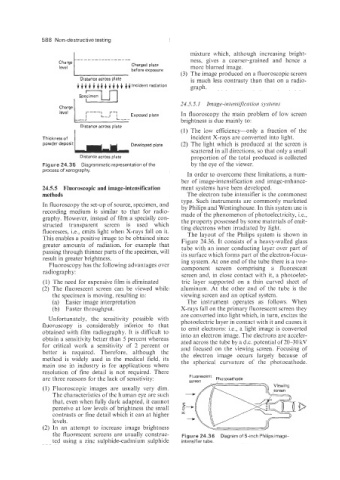
              fluoresces, Le., emits light when X-rays fall on it.   The  layout  of  the  Philips  system is  shown in
              This enables a positive image to be obtained since   Figure 24.36. It consists of a heavy-walled glass
              greater  amounts  of  radiation,  for  example  that   tube with an inner conducting layer over part of
              passing through thinner parts of the specimen, will   its surface which forms part of the electron-focus-
              result in greater brightness.            ing system. At one end of the tube there is a two-
                Fluoroscopy has the following advantages over   component  screen  comprising  a  fluorescent
              radiography:
                                                       screen and, in close contact with it, a photoelec-
              (1)  The need for expensive film is eliminated   tric  layer  supported  on  a  thin  curved  sheet  of
              (2) The  fluorescent  screen can  be  viewed  while   aluminum.  At  the  other  end  of  the  tube  is  the
                 the specimen is moving, resulting in:   viewing screen and an optical system.
                 (a)  Easier image interpretation        The  instrument  operates  as  follows.  When
                 (b)  Faster throughput.               X-rays fall on the primary fluorescent screen they
                                                       are converted into light which, in turn, excites the
                Unfortunately,  the  sensitivity  possible  with   photoelectric layer in contact with it and causes it
              fluoroscopy  is  considerably  inferior  to  that   to emit electrons: Le., a light image is converted
              obtained with film radiography.  It is difficult to   into an electron image. The electrons are acceler-
              obtain a sensitivity better than 5 percent whereas
              for  critical  work  a  sensitivity  of  2  percent  or   ated across the tube by a d.c. potential of 20-30  kV
                                                       and  focused  on  the  viewing  screen. Focusing of
              better  is  required.  Therefore:  although  the   the  electron  image  occurs  largely  because  of
              method  is  widely  used  in  the  medical  field; its   the  spherical  curvature  of  the  photocathode.
              main  use  in  industry  is  for  applications  where
              resolution  of  fine  detail  is  not  required.  There
              are three reasons for the lack of sensitivity:   Screen Fluorescent  Photocathode
              (1)  Fluoroscopic  images  are  usually  very  dim.
                 The characteristics of the human eye are such
                 that, even when fully dark adapted, it cannot
                 perceive at low levels of brightness the small
                 contrasts or fine detail which it can at higher   X
                 levels.
              (2)  In  an  attempt  to  increase  image  brightness
                 the fluorescent  screens are usually construc-   Figure 24.36  Diagram of 5-inch Philips image-
                 ted  using  a zinc sulphide-cadmium  sulphide   intensifier tube.

