


Page 611 - Instrumentation Reference Book 3E
P. 611
References 593

                              Acoustic camera


               -%-
                                                      Surface


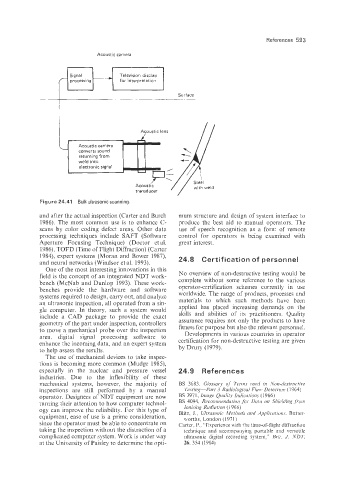
             Figur'e 24.41  Bulk ultrasonicscanning.
             and after the actual inspection (Carter and Burch   mum structure and design of system interface to
             1986). The  most  common use  is  to  enhance C-   produce  the  best  aid  to  manual  operators.  The
             scans  by  color  coding  defect  areas.  Other  data   use  of  speech recognition  as  a  form  of  remote
             processing  techniques  include  SAFT  (Software   control  for  operators  is  being  examined  with
             Aperture  Focusing  Technique)  (Doctor  et al.   great interest.
             1986), TOFD (Time of Flight Diffraction) (Carter
             198.1); expert systems (Moran and Bower  1987),
             and neural networks (Windsor et al. 1993).   24.8  Certification of personnel
               One of the most interesting innovations in this
             field is the concept of an integrated NDT work-   No overview  of non-destructive testing would  be
             bench  (McNab and Dunlop  1993). These work-   complete without  some reference to  the  various
             benches  provide  the  hardware  and  software   operator-certification  schemes  currently  in  use
             systems required to design, carry out, and analyze   worldwide. The range of products. processes and
             an ultrasonic inspection, all operated from a sin-   materials  to  which  such  methods  have  been
             gle  computer.  In  theory,  such  a  system  would   applied  has  placed  increasing  demands  on  the
             include  a  CAD  package  to  provide  the  exact   skills  and  abilities  of  its  practitioners.  Quality
             geometry of the part under inspection, controllers   assurance requires not  only the products  to have
                                                      fitness for purpose but also the relevant personnel.
             to move a mechanical probe over the inspection   Developments in various countries in operator
             area,  digital  signal  processing  software  to   certification for non-destructive testing are given
             enhance the incoming data, and an expert system   by Drury (1979).
             to help assess the results.
               The use of mechanical devices to take inspec-
             tions is becoming more common (Mudge  1985),
             especially  in  the  nuclear  and  pressure  vessel   24.9  References
             industries.  Due  to  the  inflexibility  of  these
             mechanical  systems,  however,  the  majority  of   BS  3683.  Glossary  of  Ternis  used  ir7  Xon-destructive
             inspections  are  still  performed  by  a  manual   Testiiig-Purt  3 Radiological Flaw Detection (1964)
             operator. Designers of NDT equipment are now   BS 3971, Image Quality Iiidications (1966)
             turning their attention to how computer technol-   BS  4094, Recoiiiii~mdutioi~ for  Datu  on  Shielding from
                                                        Ionising  Radiation (1966)
             ogy can improve the reliability. For this type of   Blitz,  J.,  Ultrusonic Methods  and  Applications.  Butter-
             equipment, ease of use is a prime consideration,   worths, London (1971)
             since the operator must be able to concentrate on   Carter, P., "Experience with the time-of-flight diffraction
             taking the inspection without the distraction of a   technique  and  accompanying  portable  and  versatile
             complicated computer system. Work is under way   ultrasonic  digital  recording  system."  Brit.  J.  NDT,
             at the University of Paisley to determine the opti-   26. 354 (1984)

