


Page 610 - Instrumentation Reference Book 3E
P. 610
592  Non-destructive testing
            24.6.7  Other non-destructive testing techniques   those below the optimum required to break down
                                                      the  surface barriers.  The technique,  however, is
            There are a variety of other non-destructive tech-   an  obvious choice to first evaluate  MPI indica-
            niques which have not yet gained common accept-   tions in order to differentiate purely surface fea-
            ance  within  the  oil  industry  but  are  subject  to   tures (for example, grinding marks) from cracks.
            varying degrees of investigation and experimental
            use. Some of these are described below.
                                                      24.6.7.3  Bulk ultrasonic scanning
            24.6.7. I  Eddy current                   The alternative to adapting surface non-destruc-
            Eddy-current techniques are described in Section   tive  testing  methods  is  to  use  the  surrounding
            24.3.4. The method can, with suitable head ampli-   water  as a  couplant  to  transfer  a  large amount
            fication,  be  used  for  a  search-and-follow  tech-   of ultrasonic energy into the structure and then
            nique. Whilst it will not detect sub-surface cracks,   monitor the returning energy by scanning either a
            the  degree  of  surface cleaning both  on  the  weld   single detector or the response from a tube from
            and  to each  side  is  not  critical. Thus  substantial   which acoustic energy can be used to construct a
            savings in  preparation  and  reprotection  can  be   visual image (Figure 24.41). Such techniques are
            made.                                     experimental but initial results indicate that very
                                                      rapid  inspection rates  can  be  obtained with  the
                                                      diver entirely relegated to positioning the sensor,
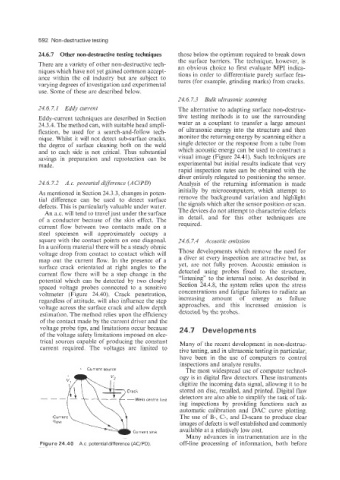
            24.6.7.2  A.c. potential difference (ACIPD)   Analysis  of  the  returning  information  is  made
            As mentioned in Section 24.3.3, changes in poten-   initially  by  microcomputers,  which  attempt  to
             tial  difference  can  be  used  to  detect  surface   remove the  background  variation  and highlight
             defects. This is particularly valuable under water.   the signals which alter the sensor position or scan.
              An a.c. will tend to travel just under the surface   The devices do not attempt to characterize defects
             of  a  conductor  because  of  the  skin  effect. The   in  detail,  and  for  this  other  techniques  are
             current  flow  between  two  contacts  made  on  a   required.
             steel  specimen  will  approximately  occupy  a
             square with  the contact points  on one diagonal.   24.6.7.4  Acoustic emission
             In a uniform material there will be a steady ohmic
             voltage drop from contact to contact which will   Those developments which remove the need for
             map  out  the current  flow. In  the presence of  a   a diver at every inspection are attractive but,  as
             surface  crack  orientated  at  right  angles  to  the   yet,  are  not  fully  proven.  Acoustic  emission  is
             current  flow there  will  be  a  step change  in  the   detected  using  probes  fixed  to  the  structure,
             potential  which  can  be  detected  by  two  closely   “listening” to the internal noise. As described in
             spaced  voltage  probes  connected  to  a  sensitive   Section 24.4.8,  the  system  relies  upon  the  stress
             voltmeter  (Figure  24.40).  Crack  penetration,   concentrations and fatigue failures to radiate an
             regardless of attitude, will also influence the step   increasing  amount  of  energy  as  failure
             voltage across the surface crack and allow depth   approaches,  and  this  increased  emission  is
             estimation. The method relies upon the efficiency   detected by the probes.
             of the contact made by the current driver and the
             voltage probe tips, and limitations occur because   24.7 Developments
             of the voltage safety limitations imposed on elec-
             trical sources capable of  producing the constant   Many of the recent development in non-destruc-
             current  required.  The  voltages  are  limited  to   tive testing, and in ultrasonic testing in particular,
                                                      have  been  in  the  use  of  computers  to  control
                                                      inspections and analyze results.
                        +  Current source               The most widespread use of computer technol-
                                                      ogy is in digital flaw detectors. These instruments
                                                      digitize the incoming data signal, allowing it to be
                                      Crack           stored on disc, recalled, and printed. Digital flaw
                                                      detectors are also able to simplify the task of tak-
                                      -Wela   centre line
                                                      ing  inspections by  providing  functions  such  as
                                                      automatic  calibration  and  DAC  curve  plotting.
                Current                               The use of B-,  C-, and D-scans to produce clear
                 flow                                 images of defects is well established and commonly
                                                      available at a relatively low cost.
                                        Current sink
                                     -                  Many  advances in instrumentation  are in the
             Figure 24.40 A.c. potential difference (AC/PD)   off-line processing  of  information,  both  before

