


Page 609 - Instrumentation Reference Book 3E
P. 609
Underwater non-destructive testing  591

                                               Wincl   ne


                                                           safety
                                                           cut-outs
                                  Sea level


                        Parallel conductor


             center
             line


                                                      I


                           Hand-held ultraviolet
                          with ink dispenser
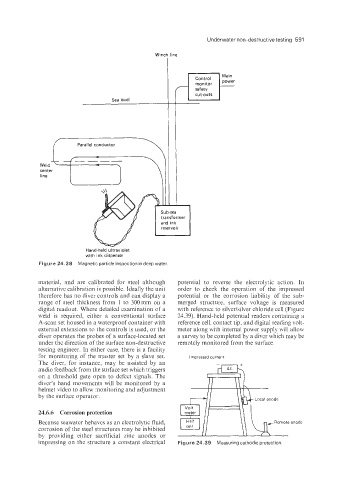
             Figure 24.38 Magnetic particle inspection in deep water.


            material,  and  are  calibrated  for  steel  although   potential  to  reverse  the  electrolytic  action.  In
             alternative calibration is possible. Ideally the unit   order  to  check  the  operation  of  the  impressed
             therefore has no diver controls and can display a   potential  or  the  corrosion  liability  of  the  sub-
             range  of  steel thickness from  1 to  300mm on  a   merged  structure,  surface  voltage  is  measured
             digital readout. Where detailed examination of a   with reference to silver/silver chloride cell (Figure
             weld  is  required,  either  a  conventional  surface   24.39). Hand-held potential readers containing a
             A-scan set housed in a waterproof container with   reference cell, contact tip, and digital reading volt-
             external extensions to the controls is used, or the   meter along with internal power supply will allow
             diver operates the probes of a surface-located set   a survey to be completed by a diver which may be
             under the direction of the surface non-destructive   remotely monitored from the surface.
             testing engineer. In either case, there is a facility
             for monitoring  of  the master  set by  a  slave set.   impressed current
             The  diver,  for  instance,  may  be  assisted  by  an
            audio feedback from the surface set which triggers
             on  a  threshold  gate  open  to  defect signals. The
             diver's  hand  movements will be monitored  by  a
            helmet video to allow monitoring and adjustment
            by the surface operator.

            24.6.61  Corrosion protection
            Because seawater behaves as an electrolytic fluid,                         anode
            corrosion of the steel structures may be inhibited
             by  providing  either  sacrificial  zinc  anodes  or
            impressing on the structure a constant  electrical   Figure 24.39  Measuring cathodic protection.

