


Page 605 - Instrumentation Reference Book 3E
P. 605
Radiography 587

             Table 24.3 Voltage-doubling circuits:  (a) Villard; (b)   Table 24.4  Hole and step dimensions for IQI
             Greinaclner constant-potential
                                                      Step   Diurneter  and   Step   Dianietev and
             Wive  Diameter   Wive  Diameter   Wire  Diameter   no.   step  thickness   no.   step  thickness
             no.   (mm)   no.   (mm)   no.   (mm)             (mm)                 (mm)
                                                      __                  ~
             1    0.032    8   0.160   15   0.80      1      0.125         10      1 .oo
             2    0.010    9   0.200   16   1.00      2      0.160         11      1.25
             3    0.050   10   0.250   17   1.25      3      0.200         12      1.60
             4    0.063   11   0.320   18   1.00      4      0.250         13     2.00
             5    0.080   12   0.400   19   2.00      5      0.320         14     2.50
             6    0.100   13   0.500   20   2.50      6      0.400         15     3.20
             7    0.125   14   0.63    21   3.20      7      0.500         16     4.00
                                                      8      0.630         17     5.00
                                                      9      0.800         18     6.30


                                                      Table 24.5  Step and holes included in different models of
                                                      IQi
                                                      Model                    Step and hde sizes
                                                      A                          1-6  inclusive
                                                      B                         7-12  inclusive
                                                      C                        !3-18  inclusive


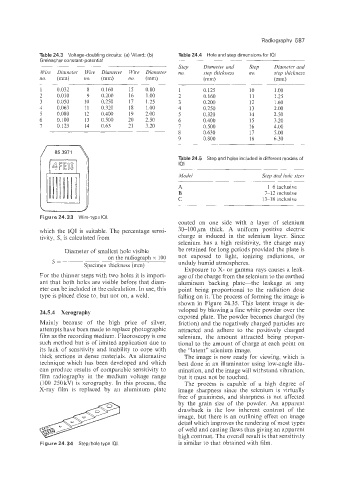
             Figure 24.33  Wire-typo 101.
                                                      coated  on  one  side  with  a  layer  of  selenium
             which the  IQI is  suitable. The percentage  sensi-   30-100  pm  thick.  A  uniform  positive  electric
             tivity, S, is calculated from            charge  is  induced  in  the  selenium  layer.  Since
                                                      selenium has  a  high  resistivity, the  charge  may
                    Diameter of smallest hole visible   be retained for long periods provided the plate is
                                 on the radiograph x  100   not  exposed  to  light,  ionizing  radiations,  or
                S=                                    unduly humid atmospheres.
                          Specimen thickness (mm)
                                                        Exposure to X- or gamma rays causes a leak-
             For the thinner steps with two holes it is import-   age of the charge from the selenium to the earthed
             ant thLat  both holes are visible before that diam-   aluminum  backing  plate-the   leakage  at  any
             eter can be included in the calculation. In use, this   point  being  proportional to  the  radiation  dose
             type is placed close to, but not on, a weld.   falling on it. The process of forming the image is
                                                      shown in  Figure  24.35. This latent  image is de-
             24.5.4,  Xerography                      veloped by blowing a fine white powder over the
                                                      exposed plate. The powder becomes charged (by
             Mainly  because  of  the  high  price  of  silver.   friction) and the negatively charged particles are
             attempts have been made to replace photographic   attracted  and  adhere  to  the  positively  charged
             film as the recording medium. Fluoroscopy is one   selenium,  the  amount  attracted  being  propor-
             such imethod but is of limited application due to   tional to the amount of  charge at each point  on
             its lack  of  sensitivity and inability  to cope with   the "latent"  selenium image.
             thick  sections in dense materials.  An alternative   The image is now ready  for viewing, which is
             technique  which  has  been  developed and which   best done in an illuminator  using low-angle illu-
             can produce  results of  comparable sensitivity to   mination, and the image will withstand vibration,
             film  radiography  in  the  medium  voltage  range   but it must not be touched.
             (100-250 kV)  is xerography. In  this process, the   The  process  is  capable  of  a  high  degree  of
             X-ray  film  is  replaced  by  an  aluminum  plate   image  sharpness  since the  selenium  is  virtually
                                                      free of  graininess, and sharpness is not affected
                                                      by  the  grain  size  of  the  powder.  An  apparent
                                                      drawback  is  the  low  inherent  contrast  of  the
                                                      image, but there is  an outlining effect on image
                                                      detail which improves the rendering of most types
                                                      of weld and casting flaws thus giving an apparent
                                                      high contrast. The overall result is that sensitivity
             Figure 24.34  Stepiholetype IQI.         is similar to that obtained with film.

