


Page 602 - Instrumentation Reference Book 3E
P. 602
584  Non-destructive testing

                                                     In operation a d.c. voltage in the range 100 kV to
              Wavelength             Nature of radiation   2 MV is applied between a heated, spirally wound
                -12                                  filament (the cathode) and the positively charged
                -1 1                                 fairly  massive  copper  anode.  The  anode  has
                -10                                  embedded in it a tungsten insert or target of effect-
                -9                                   ive area 2-4mm2  and it is on to this target that
                -8                                   the electrons are focused. The anode and cathode
                -7                                   are placed about 50 mm apart, and the tube current
                -6                                    is  kept  low (5-10mA)  in  order to prevent over-
                -5                                   heating of the anode. Typical voltages for a range
                -4
              E                                       of steel thicknesses are shown in Table 24.2.
              E   -3   .   1 ,urn = 1000 nm
              D                                        The high voltage needed to produce the X-rays
              J   -2                                  is  obtained  by  relatively  simple  circuitry  con-
                -1            100 ,urn-               sisting of suitable combinations of transformers,
                 0       1  mm = 1000,um-
                 1        1 cm = 10 rnm-              rectifiers, and capacitors. Two of the more widely
                 2             10cm-   Radar          used  circuits  are the  Villard,  which  produces  a
                 3        1 m = 100 Cm-   Television   pulsating output, and the Greinacher, producing
                 4             10m-   Radio           an  almost  constant  potential  output. These  are
                 5             ,oo  -   and similar radiation   shown in Figure 24.32 along with the form of the
                 6            1000 m-                 resulting voltage. A voltage stabilizer at the 240 V
                 7           10 000 m,                input stage is desirable.
                                                       Exposure  (the  product  of  current  and  time)
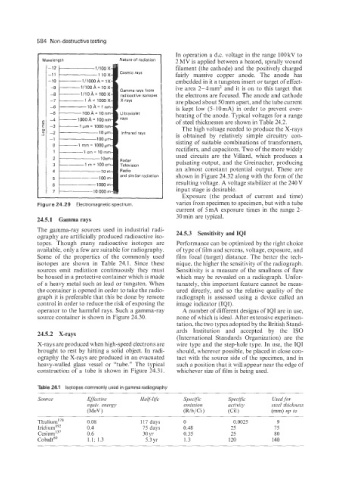
            Figure 24.29  Electromagnetic spectrum.   varies from specimen to specimen, but with a tube
                                                      current  of  5mA exposure  times in the range  2-
            24.5.1  Gamma rays                        30 min are typical.
            The  gamma-ray  sources used  in industrial  radi-   24.5.3  Sensitivity and IQI
            ography are artificially produced radioactive iso-
            topes.  Though  many  radioactive  isotopes  are   Performance can be optimized by the right choice
            available, only a few are suitable for radiography.   of type of film and screens, voltage, exposure, and
            Some  of  the  properties  of  the  commonly  used   film focal (target)  distance.  The better the tech-
            isotopes  are  shown  in  Table  24.1.  Since  these   nique, the higher the sensitivity of the radiograph.
            sources  emit  radiation  continuously  they  must   Sensitivity is a measure of the smallness of flaw
            be housed in a protective container which is made   which may be revealed on a radiograph.  Unfor-
            of a heavy metal such as lead or tungsten. When   tunately, this important feature cannot be meas-
            the container is opened in order to take the radio-   ured  directly, and  so the  relative quality  of  the
            graph it is preferable that this be done by remote   radiograph  is  assessed using  a  device called  an
            control in order to reduce the risk of exposing the   image indicator (IQI).
            operator to the harmful rays. Such a gamma-ray   A number of different designs of IQI are in use,
            source container is shown in Figure 24.30.   none of which is ideal. After extensive experimen-
                                                      tation, the two types adopted by the British Stand-
                                                      ards  Institution  and  accepted  by  the  IS0
            24.5.2  X-rays
                                                      (International  Standards Organization)  are  the
            X-rays are produced when high-speed electrons are   wire type and the step-hole type. In use, the IQI
            brought to rest by  hitting a solid object. In radi-   should, wherever possible, be placed in close con-
            ography the X-rays are produced in an evacuated   tact with the source side of the specimen, and in
            heavy-walled glass vessel  or  "tube."  The  typical   such a position that it will appear near the edge of
            construction  of  a tube is  shown in  Figure 24.31.   whichever size of film is being used.

            Table 24.1  Isotopes commonly used in gamma radiography

            Source         Effective       Half-life    Specific     Specific     Usedfor
                           equir. energy                emission     activity     steel thickness
                           (MeV 1                       (R/h/Ci )    (Cil)        (mm) up to
            Thulium' 'O    0.08            117 days     0              0.0025       9
             Iridium'9z    0.4              75 days     0.48          25           75
             ~esiurn'~~    0.6              30 yr       0.35          25           80
            Cobalt6'       1.1; 1.3         5.3 yr      1.3          120          140

