


Page 397 - Introduction to AI Robotics
P. 397
380
                                                                                  Localization and Map Making
                                                                               11


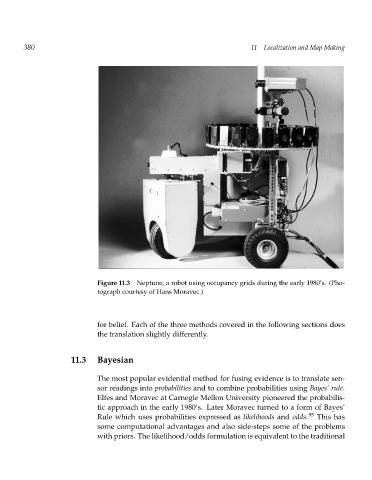
                                     Figure 11.3 Neptune, a robot using occupancy grids during the early 1980’s. (Pho-
                                     tograph courtesy of Hans Moravec.)


                                     for belief. Each of the three methods covered in the following sections does
                                     the translation slightly differently.


                              11.3   Bayesian

                                     The most popular evidential method for fusing evidence is to translate sen-
                                     sor readings into probabilities and to combine probabilities using Bayes’ rule.
                                     Elfes and Moravec at Carnegie Mellon University pioneered the probabilis-
                                     tic approach in the early 1980’s. Later Moravec turned to a form of Bayes’
                                     Rule which uses probabilities expressed as likelihoods and odds. 95  This has
                                     some computational advantages and also side-steps some of the problems
                                     with priors. The likelihood/odds formulation is equivalent to the traditional

