


Page 521 - Introduction to Information Optics
P. 521
506                      9. Computing with Optics

       As a result, the logical operations required in MSD addition can be considered
       as the signed version of that in traditional binary addition.


          9.4.2.2.2. Two-Step MSD Addition/Subtraction
          The previous algorithm used two steps to guarantee that the third-step
       addition is carry free. The first two steps can be combined into a single step
       operation. For example, Li and Eichman [74] suggested the conditional
       symbolic substitution rules, where in addition to the digit pairs 0,6,- to be
       substituted, a lower-level digit pair a i_ 1b i_ l is used as the reference digits. In
       the second step, the transfer and weight digits are added to yield carry-free
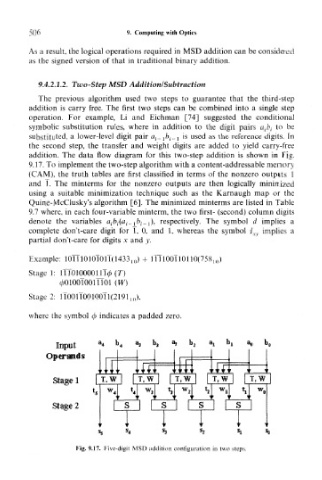
       addition. The data flow diagram for this two-step addition is shown in Fig.
       9.17. To implement the two-step algorithm with a content-addressable memory
       (CAM), the truth tables are first classified in terms of the nonzero outputs 1
       and 1. The minterms for the nonzero outputs are then logically minimized
       using a suitable minimization technique such as the Karnaugh map or the
       Quine-McClusky's algorithm [6]. The minimized minterms are listed in Table
       9.7 where, in each four-variable minterm, the two first- (second) column digits
       denote the variables a^b^a^^b^^^}, respectively. The symbol d implies a
       complete don't-care digit for 1, 0, and 1, whereas the symbol d x implies a
       partial don't-care for digits x and v.

       Example: 10TTl010TOlT(1433 lo) + iTTlOOTlOl 10(758, 0)
       Stage 1: iTTOlOOOOllT^ (T)
               ^010010011101 (W)
       Stage 2: lTOOlT00100Tl(2191 10),

       where the symbol (/> indicates a padded zero.


                                                     a   b
              Input                                  i    i
            Operands


             Stage 1    I T.W I  I T. w     T.W       T. w


             Stage 2


                   Fig. 9.17. Five-digit MSD addition configuration in two steps.

