


Page 663 - Introduction to Information Optics
P. 663
11.4. Information Display Using Electro-Optic Spatial Light Modulators  647

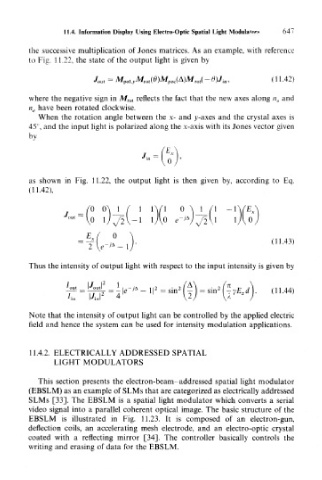
       the successive multiplication of Jones matrices. As an example, with reference
       to Fig. 11,22, the state of the output light is given by

                       /out - M poU,M rot(0)M poc(A)M rot(-^)J in,  (11.42)

       where the negative sign in M rot reflects the fact that the new axes along n n and
       n e have been rotated clockwise.
          When the rotation angle between the x- and y-axes and the crystal axes is
       45°, and the input light is polarized along the x-axis with its Jones vector given
       by'
                                         'F
                                    J - I *
                                     ;
                                     " ~ ' 0
       as shown in Fig. 11.22, the output light is then given by, according to Eq.
       (11.42),

                      Q
                    -(  °^   * (   l lVl     0 \ 1 /I -1VE,
                /out - I Q

                                                                    (11.43)


       Thus the intensity of output light with respect to the input intensity is given by


                      17 I  2  4              V 2
                 I J  i n  l-'inl  ^          \  Z
       Note that the intensity of output light can be controlled by the applied electric
       field and hence the system can be used for intensity modulation applications.


       11.4.2. ELECTRICALLY ADDRESSED SPATIAL
              LIGHT MODULATORS

         This section presents the electron-beam-addressed spatial light modulator
       (EBSLM) as an example of SLMs that are categorized as electrically addressed
       SLMs [33]. The EBSLM is a spatial light modulator which converts a serial
       video signal into a parallel coherent optical image. The basic structure of the
       EBSLM is illustrated in Fig. 11.23. It is composed of an electron-gun,
       deflection coils, an accelerating mesh electrode, and an electro-optic crystal
       coated with a reflecting mirror [34]. The controller basically controls the
       writing and erasing of data for the EBSLM.

