


Page 661 - Introduction to Information Optics
P. 661
1 1.4. Information Display Using Electro-Optic Spatial Light Modulators  645

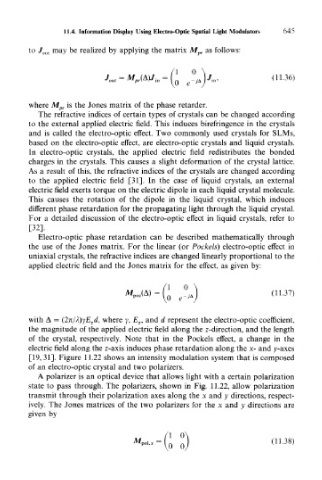
       to J out may be realized by applying the matrix M pr as follows:


                            out = M pr(A)/ in =   A / in,           (1 1.36)


       where M pr is the Jones matrix of the phase retarder.
          The refractive indices of certain types of crystals can be changed according
       to the external applied electric field. This induces birefringence in the crystals
       and is called the electro-optic effect. Two commonly used crystals for SLMs,
       based on the electro-optic effect, are electro-optic crystals and liquid crystals.
       In electro-optic crystals, the applied electric field redistributes the bonded
       charges in the crystals. This causes a slight deformation of the crystal lattice.
       As a result of this, the refractive indices of the crystals are changed according
       to the applied electric field [31]. In the case of liquid crystals, an external
       electric field exerts torque on the electric dipole in each liquid crystal molecule.
       This causes the rotation of the dipole in the liquid crystal, which induces
       different phase retardation for the propagating light through the liquid crystal.
       For a detailed discussion of the electro-optic effect in liquid crystals, refer to
       [32].
          Electro-optic phase retardation can be described mathematically through
       the use of the Jones matrix. For the linear (or Pockets) electro-optic effect in
       uniaxial crystals, the refractive indices are changed linearly proportional to the
       applied electric field and the Jones matrix for the effect, as given by:


       with A = (2n/A)yE zd, where y, E z, and d represent the electro-optic coefficient,
       the magnitude of the applied electric field along the z-direction, and the length
       of the crystal, respectively. Note that in the Pockels effect, a change in the
       electric field along the z-axis induces phase retardation along the x- and >'-axes
       [19,31]. Figure 11.22 shows an intensity modulation system that is composed
       of an electro-optic crystal and two polarizers.
          A polarizer is an optical device that allows light with a certain polarization
       state to pass through. The polarizers, shown in Fig. 11.22, allow polarization
       transmit through their polarization axes along the x and y directions, respect-
       ively. The Jones matrices of the two polarizers for the x and y directions are
       given by


                                                                     (H.38)

