


Page 379 - Introduction to Marine Engineering
P. 379
Appendix


         The appendix is reserved for all those topics which, although very useful,
         do not quite fit in elsewhere. As an introduction,  or a reminder, a section
         on SI units (Systeme International  d'Unites) is given together with some
         conversions  to the older  system of Imperial  units. Various  engineering
         calculations  relating  to  power  measurement and  fuel  consumption  are
         explained,  together  with  worked  examples.  So that  the  production  of
         manufacturing drawings of a fairly  simple nature can be accomplished,
         an  introduction  to engineering  drawing is provided.


         SI units

         The  metric  system of units, which  is intended  to  provide  international
         unification  of physical measurements and  quantities, is referred  to as SI
         units.
           There  are  three  classes  of  units:  base,  supplementary  and  derived.
         There  are  seven  base  units:  length—metre  (m);  mass—kilogram (kg);
         time—sound   (s);  electric  current—ampere  (A); temperature—keivin
         (K); luminous intensity—candela (cd); and  amount of substance—mole
         (mol). There are  two supplementary  units:  plane  angle—radian  (rad);
         solid  angle—steradian  (sr).  AH remaining units used  are  derived  from
         the base units. The  derived  units are coherent  in that the multiplication
         or division of base units produces  the derived unit. Examples of derived
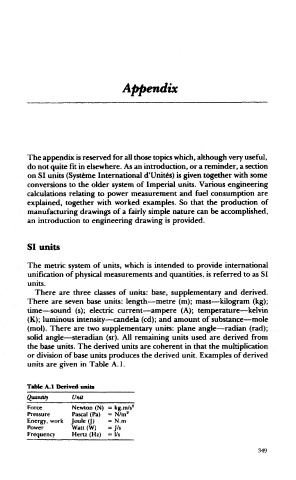
         units are  given in Table A. 1.


         Table A.I  Derived units
         Quantity    Unit
         Force       Newton (N) =  kg.m/s 2
         Pressure    Pascal (Pa)  -  N/m  2
         Energy, work  Joule (J)  -  N.m
         Power       Watt (W)  -J/s
         Frequency   Hertz (Hz) =  l/s

                                                                       349

