


Page 381 - Introduction to Marine Engineering
P. 381
Appendix  351

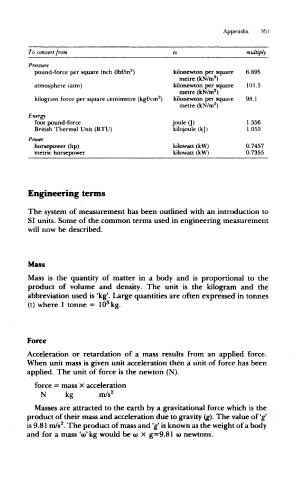
         To  convert  from                                          multiply

         Pressure
                                     2
           pound-force  per square  inch  (lbf/in )  kilonewton  per square  6.895
                                                           2
                                                  metre (kN/m )
           atmosphere (attn)                    kilonewton  per square  101.3
                                                           2
                                                  metre (kN/m )
                                            2
           kilogram  force  per square centimetre  (kgf/cm )  kilonewton  per square  98.1
                                                           2
                                                  metre  (kN/m )
         Energy
           foot  pound-force                    joule  (J)          1.356
           British Thermal  Unit (BTU)          kilojoule  (kj)     1.055
          Power
           horsepower (hp)                      kilowatt (kW)       0.7457
           metric  horsepower                   kilowatt (kW)      0.7355


         Engineering terms

         The  system of measurement  has been  outlined  with  an introduction  to
         SI units. Some of the common terms used  in engineering measurement
         will  now be  described.


         Mass
         Mass  is  the  quantity of  matter  in  a  body  and  is  proportional  to  the
         product  of  volume  and  density.  The  unit  is  the  kilogram  and  the
         abbreviation  used  is 'kg'. Large quantities are often expressed  in  tonnes
                              s
         (t) where  1 tonne  =  10  kg.


         Force
         Acceleration  or  retardation  of  a  mass  results  from  an  applied  force.
         When unit mass is given unit acceleration then a unit of force has been
         applied.  The  unit of force is the  newton  (N).
           force = mass X acceleration
                               2
             N     kg       m/s
           Masses are  attracted  to the earth  by a gravitational  force which is the
         product  of their mass and acceleration due to gravity (g). The  value  of'g'
                  2
         is 9.81 m/s . The  product  of mass and  'g'  is known as the weight of a body
         and  for  a  mass 'w'kg would be  w  x  g=9.81  <u newtons.

