


Page 384 - Introduction to Marine Engineering
P. 384
354  Appendix

                 will  be  used  to  drive  the  rotating  masses  of  the  engine.  The  power
                 produced  in  the  cylinder  can  be  measured  by. an  engine  indicator
                 mechanism as described in Chapter  2. This power is often  referred  to as
                 Indicated  power'. The  power output of the engine is known as 'shaft'  or
                 'brake  power'. On  smaller  engines  it could  be  measured  by applying a
                 type of brake  to the shaft, hence  the  name.

                 Indicated  power
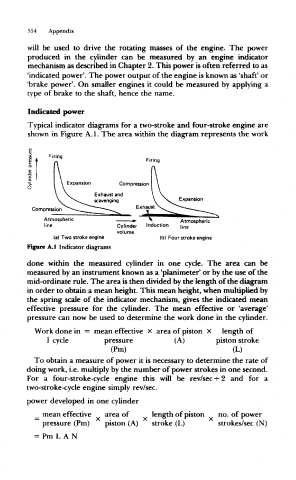
                 Typical indicator diagrams  for a two-stroke and  four-stroke  engine  are
                 shown  in Figure A. 1. The  area  within the diagram  represents the work


                       Firing
                                                 Firing


                  Compression
                     Atmospheric
                     tine                Cylinder
                                         volume
                        (a)  Two stroke engine      fb)  Four stroke engine
                 Figure A.1  Indicator  diagrams

                 done  within  the  measured  cylinder  in  one  cycle.  The  area  can  be
                 measured  by an instrument known as a 'planimeter* or by the use of  the
                 mid-ordinate rule. The  area  is then divided  by the length  of the diagram
                 in order to obtain  a mean height. This mean height, when multiplied by
                 the  spring  scale  of  the  indicator  mechanism,  gives the  indicated  mean
                 effective  pressure  for  the  cylinder.  The  mean  effective  or  'average'
                 pressure  can now be used  to determine  the  work done in the  cylinder.
                   Work done in  =  mean effective  x  area of piston  X  length of
                      1  cycle        pressure          (A)        piston stroke
                                       (Pm)                             (L)
                   To obtain a measure of power it is necessary to determine  the  rate of
                 doing work, i.e. multiply by the number of power strokes in one second.
                 For  a  four-stroke-cycle  engine  this  will  be  rev/sec -r 2  and  for  a
                 two-stroke-cycle engine simply rev/sec.

                 power  developed  in one cylinder
                   _  mean effective  area  of    length of piston  no. of power
                     pressure  (Pm)   piston (A)  stroke (L)        strokes/sec  (N)
                   =  Pm  L A N

