


Page 380 - Introduction to Marine Engineering
P. 380
350  Appendix

                   There  are  in  use  certain  units  which  are  non-Si  but  are  retained
                 because of their practical importance.  Examples are: time—days, hours,
                 minutes and  speed—knots.
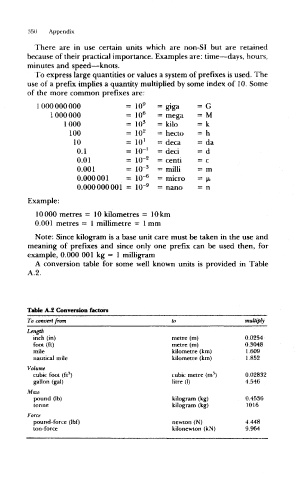
                   To express  large quantities or values a system of prefixes is used.  The
                 use of a prefix  implies  a quantity  multiplied  by some  index  of  10, Some
                 of  the  more  common  prefixes are:
                                                9
                   I  000 000  000           10    =  giga    =  G
                       1000000               10 6  =  mega    =  M
                                                3
                          1000               10    =  kilo    """""  IV
                                                2
                            100              10    =  hecto   =  h
                             10               10'  =  deca    =  da
                              0.1             10" 1  =  deci  =  d
                              0.01            10~ 2  =  centi  =  c
                              0.001          10" 3  =  milli  =  m
                                           =
                                              1U~"
                              0.000001     =  10 -  =  micro
                              0.000000001  =  10 r-9  _  nano  —  n
                 Example:
                   10000 metres  =  10 kilometres  =  10km
                   0.001  metres  =  1 millimetre =  1 mm

                   Note: Since kilogram  is a base  unit care  must be taken  in the  use  and
                 meaning  of  prefixes  and  since  only one  prefix  can  be  used  then,  for
                 example,  0.000 001 kg  =  1 milligram
                   A  conversion  table  for  some  well  known units  is  provided  in  Table
                 A.2.


                 Table A.2 Conversion  factors
                 To convert from                       to                  multiply
                 Length
                  inch (in)                            metre (m)           0.0254
                  foot  (ft)                           metre (m)           0,3048
                  mile                                 kilometre  (km)     1.609
                  nautical  mile                       kilometre (km)      1.852
                 Volume
                                                                  3
                            3
                  cubic foot  (ft )                    cubic metre (m )    0.02832
                  gallon (gal)                         litre (1)           4.546
                 Mass
                  pound  (Ib)                          kilogram (kg)       0.4536
                  tonne                                kilogram (kg)       1016
                 Force
                  pound-force  (Ibf)                   newton  (N)         4.448
                  ton- force                           kilonewton  (kN)    9.964

