


Page 153 - Introduction to Mineral Exploration
P. 153
136   J. MILSOM


                                                              uranium in the potassium window. It is usual
                     Counts                                   to also record total count but discrimination is
                                                              important, as was shown by the discovery of
                                                              the Yeeleerie uranium deposit in Western Aus-
                  10,000
                                                              tralia in a salt lake where the radiometric
                                                              anomaly had initially been attributed to potash
                                                              in the evaporites. Interpretational difficulties
                                                              are introduced in the search for uranium by the
                   1000                                       fact that   214 Bi lies below radon in the decay
                                                              chain. Radon is a gas and the isotope concerned
                                                              has a half-life of several days, allowing con-
                                          Potassium           siderable dispersion from the primary source.
                                          (1.46 MeV)
                    100                                         The unpopularity of nuclear power, and the
                                                              availability of uranium from dismantled nu-
                                                              clear bombs, made exploration for uranium
                                            Uranium
                                            (1.76 MeV)        much less attractive, and the importance of
                                                  Thorium     radiometric methods declined accordingly.
                     10                           (2.615 MeV)  Much of the radiometric work being under-
                                                              taken at present is for public health purposes
                                                              and in such applications the monitoring of
                                                              alpha particles from radon gas using alpha cups
                                                              and alpha cards may be as useful as the detec-
                               1.0     2.0                    tion of gamma rays. Gamma-ray surveys do,
                                                              however, have geological applications in locat-
                                            Energy (MeV)
                                                              ing alteration zones in acid and intermediate
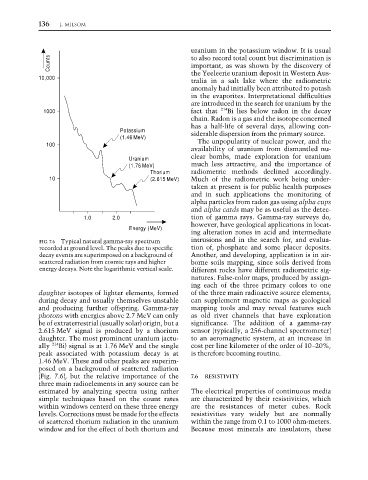
                  FIG. 7.6 Typical natural gamma-ray spectrum  intrusions and in the search for, and evalua-
                  recorded at ground level. The peaks due to specific  tion of, phosphate and some placer deposits.
                  decay events are superimposed on a background of  Another, and developing, application is in air-
                  scattered radiation from cosmic rays and higher  borne soils mapping, since soils derived from
                  energy decays. Note the logarithmic vertical scale.  different rocks have different radiometric sig-
                                                              natures. False-color maps, produced by assign-
                                                              ing each of the three primary colors to one
                  daughter isotopes of lighter elements, formed  of the three main radioactive source elements,
                  during decay and usually themselves unstable  can supplement magnetic maps as geological
                  and producing further offspring. Gamma-ray  mapping tools and may reveal features such
                  photons with energies above 2.7 MeV can only  as old river channels that have exploration
                  be of extraterrestrial (usually solar) origin, but a  significance. The addition of a gamma-ray
                  2.615 MeV signal is produced by a thorium   sensor (typically, a 256-channel spectrometer)
                  daughter. The most prominent uranium (actu-  to an aeromagnetic system, at an increase in
                  ally   214 Bi) signal is at 1.76 MeV and the single  cost per line kilometer of the order of 10–20%,
                  peak associated with potassium decay is at  is therefore becoming routine.
                  1.46 MeV. These and other peaks are superim-
                  posed on a background of scattered radiation
                  (Fig. 7.6), but the relative importance of the  7.6  RESISTIVITY
                  three main radioelements in any source can be
                  estimated by analyzing spectra using rather  The electrical properties of continuous media
                  simple techniques based on the count rates  are characterized by their resistivities, which
                  within windows centerd on these three energy  are the resistances of meter cubes. Rock
                  levels. Corrections must be made for the effects  resistivities vary widely but are normally
                  of scattered thorium radiation in the uranium  within the range from 0.1 to 1000 ohm-meters.
                  window and for the effect of both thorium and  Because most minerals are insulators, these

