


Page 154 - Introduction to Mineral Exploration
P. 154
7: GEOPHYSICAL METHODS  137


                           (a) Wenner                     (b) Two-electrode (pole–pole)

                                              π
                                                                             π
                                          ρ α = 2  a  V                  ρ α  = 2  a  V
                                                I                              I
                                       I                              I           8
                                                                         V        8
                                       V
                               a       a      a                  a
                           (c) Schlumberger               (d) Gradient
                                             2
                                          2
                               Exact  ρ α  = π L  –   V    Ideal dipole ‘a’  ρ α  = π   L  2  K  V
                                           2   I                            a   I
                                              2
                           Ideal dipole ‘2 ’  ρ α  = π   L V  where K = 2π  1 − X  +  1+X
                                                                                   2
                                                                                          2 3 2
                                                                            2 3 2
                                                                     2
                                             2  I                   [y + (1 − X ) ]  [y + (1 + X ) ]
                                                                         I
                                       I                         a                 and
                                       2                         V                X = x/L
                                       V                                          Y = y/L
                                                                 y
                                       2L                   x
                                                               L          L
                           (e) Dipole–dipole  ρ α = π n (n + 1)(n + 2)a V
                                                         I
                                            V                  I
                                            a        na        a

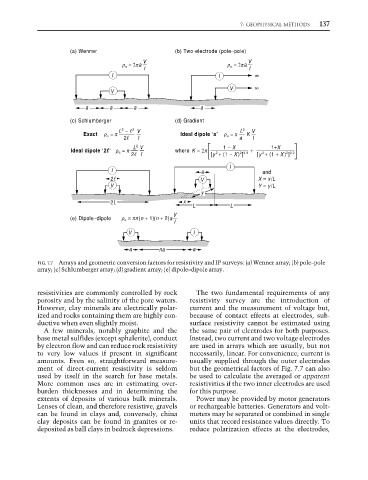
                 FIG. 7.7  Arrays and geometric conversion factors for resistivity and IP surveys: (a) Wenner array; (b) pole–pole
                 array; (c) Schlumberger array; (d) gradient array; (e) dipole–dipole array.


                 resistivities are commonly controlled by rock  The two fundamental requirements of any
                 porosity and by the salinity of the pore waters.  resistivity survey are the introduction of
                 However, clay minerals are electrically polar-  current and the measurement of voltage but,
                 ized and rocks containing them are highly con-  because of contact effects at electrodes, sub-
                 ductive when even slightly moist.            surface resistivity cannot be estimated using
                   A few minerals, notably graphite and the   the same pair of electrodes for both purposes.
                 base metal sulfides (except sphalerite), conduct  Instead, two current and two voltage electrodes
                 by electron flow and can reduce rock resistivity  are used in arrays which are usually, but not
                 to very low values if present in significant  necessarily, linear. For convenience, current is
                 amounts. Even so, straightforward measure-   usually supplied through the outer electrodes
                 ment of direct-current resistivity is seldom  but the geometrical factors of Fig. 7.7 can also
                 used by itself in the search for base metals.  be used to calculate the averaged or apparent
                 More common uses are in estimating over-     resistivities if the two inner electrodes are used
                 burden thicknesses and in determining the    for this purpose.
                 extents of deposits of various bulk minerals.  Power may be provided by motor generators
                 Lenses of clean, and therefore resistive, gravels  or rechargeable batteries. Generators and volt-
                 can be found in clays and, conversely, china  meters may be separated or combined in single
                 clay deposits can be found in granites or re-  units that record resistance values directly. To
                 deposited as ball clays in bedrock depressions.  reduce polarization effects at the electrodes,

