


Page 159 - Introduction to Mineral Exploration
P. 159
142   J. MILSOM


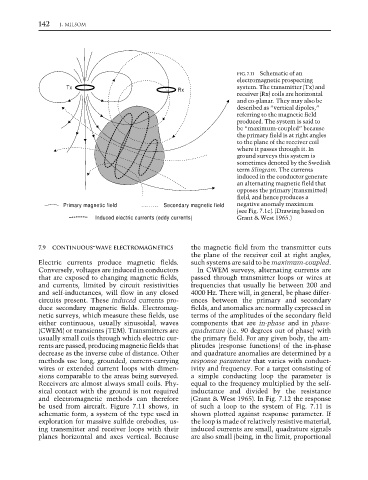
                                                                            FIG. 7.11 Schematic of an
                                                                            electromagnetic prospecting
                          Tx                                                system. The transmitter (Tx) and
                                                          Rx
                                                                            receiver (Rx) coils are horizontal
                                                                            and co-planar. They may also be
                                                                            described as “vertical dipoles,”
                                                                            referring to the magnetic field
                                                                            produced. The system is said to
                                                                            be “maximum-coupled” because
                                                                            the primary field is at right angles
                                                                            to the plane of the receiver coil
                                                                            where it passes through it. In
                                                                            ground surveys this system is
                                                                            sometimes denoted by the Swedish
                                                                            term Slingram. The currents
                                                                            induced in the conductor generate
                                                                            an alternating magnetic field that
                                                                            opposes the primary (transmitted)
                                                                            field, and hence produces a
                         Primary magnetic field       Secondary magnetic field  negative anomaly maximum
                                                                            (see Fig. 7.1c). (Drawing based on
                                  Induced electric currents (eddy currents)  Grant & West 1965.)


                  7.9  CONTINUOUS-WAVE ELECTROMAGNETICS       the magnetic field from the transmitter cuts
                                                              the plane of the receiver coil at right angles,
                  Electric currents produce magnetic fields.   such systems are said to be maximum-coupled.
                  Conversely, voltages are induced in conductors  In CWEM surveys, alternating currents are
                  that are exposed to changing magnetic fields,  passed through transmitter loops or wires at
                  and currents, limited by circuit resistivities  frequencies that usually lie between 200 and
                  and self-inductances, will flow in any closed  4000 Hz. There will, in general, be phase differ-
                  circuits present. These induced currents pro-  ences between the primary and secondary
                  duce secondary magnetic fields. Electromag-  fields, and anomalies are normally expressed in
                  netic surveys, which measure these fields, use  terms of the amplitudes of the secondary field
                  either continuous, usually sinusoidal, waves  components that are  in-phase and in  phase-
                  (CWEM) or transients (TEM). Transmitters are  quadrature (i.e. 90 degrees out of phase) with
                  usually small coils through which electric cur-  the primary field. For any given body, the am-
                  rents are passed, producing magnetic fields that  plitudes (response functions) of the in-phase
                  decrease as the inverse cube of distance. Other  and quadrature anomalies are determined by a
                  methods use long, grounded, current-carrying  response parameter that varies with conduct-
                  wires or extended current loops with dimen-  ivity and frequency. For a target consisting of
                  sions comparable to the areas being surveyed.  a simple conducting loop the parameter is
                  Receivers are almost always small coils. Phy-  equal to the frequency multiplied by the self-
                  sical contact with the ground is not required  inductance and divided by the resistance
                  and electromagnetic methods can therefore   (Grant & West 1965). In Fig. 7.12 the response
                  be used from aircraft. Figure 7.11 shows, in  of such a loop to the system of Fig. 7.11 is
                  schematic form, a system of the type used in  shown plotted against response parameter. If
                  exploration for massive sulfide orebodies, us-  the loop is made of relatively resistive material,
                  ing transmitter and receiver loops with their  induced currents are small, quadrature signals
                  planes horizontal and axes vertical. Because  are also small (being, in the limit, proportional

