


Page 162 - Introduction to Mineral Exploration
P. 162
7: GEOPHYSICAL METHODS  145


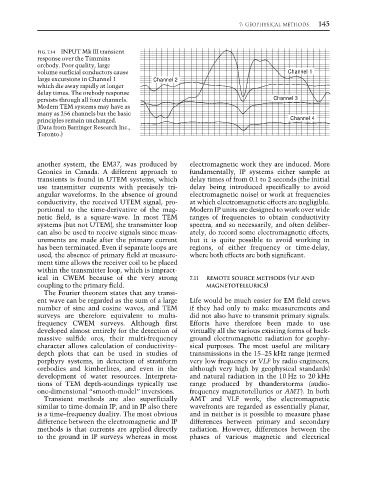
                 FIG. 7.14  INPUT Mk III transient
                 response over the Timmins
                 orebody. Poor quality, large
                 volume surficial conductors cause                                          Channel 1
                 large excursions in Channel 1     Channel 2
                 which die away rapidly at longer
                 delay times. The orebody response
                 persists through all four channels.                                  Channel 3
                 Modern TEM systems may have as
                 many as 256 channels but the basic
                 principles remain unchanged.                                              Channel 4
                 (Data from Barringer Research Inc.,
                 Toronto.)


                 another system, the EM37, was produced by    electromagnetic work they are induced. More
                 Geonics in Canada. A different approach to   fundamentally, IP systems either sample at
                 transients is found in UTEM systems, which   delay times of from 0.1 to 2 seconds (the initial
                 use transmitter currents with precisely tri-  delay being introduced specifically to avoid
                 angular waveforms. In the absence of ground  electromagnetic noise) or work at frequencies
                 conductivity, the received UTEM signal, pro-  at which electromagnetic effects are negligible.
                 portional to the time-derivative of the mag-  Modern IP units are designed to work over wide
                 netic field, is a square-wave. In most TEM    ranges of frequencies to obtain conductivity
                 systems (but not UTEM), the transmitter loop  spectra, and so necessarily, and often deliber-
                 can also be used to receive signals since meas-  ately, do record some electromagnetic effects,
                 urements are made after the primary current  but it is quite possible to avoid working in
                 has been terminated. Even if separate loops are  regions, of either frequency or time-delay,
                 used, the absence of primary field at measure-  where both effects are both significant.
                 ment time allows the receiver coil to be placed
                 within the transmitter loop, which is impract-
                 ical in CWEM because of the very strong      7.11  REMOTE SOURCE METHODS (VLF AND
                 coupling to the primary field.                     MAGNETOTELLURICS)
                   The Fourier theorem states that any transi-
                 ent wave can be regarded as the sum of a large  Life would be much easier for EM field crews
                 number of sine and cosine waves, and TEM     if they had only to make measurements and
                 surveys are therefore equivalent to multi-   did not also have to transmit primary signals.
                 frequency CWEM surveys. Although first        Efforts have therefore been made to use
                 developed almost entirely for the detection of  virtually all the various existing forms of back-
                 massive sulfide ores, their multi-frequency   ground electromagnetic radiation for geophy-
                 character allows calculation of conductivity–  sical purposes. The most useful are military
                 depth plots that can be used in studies of   transmissions in the 15–25 kHz range (termed
                 porphyry systems, in detection of stratiform  very low frequency or VLF by radio engineers,
                 orebodies and kimberlites, and even in the   although very high by geophysical standards)
                 development of water resources. Interpreta-  and natural radiation in the 10 Hz to 20 kHz
                 tions of TEM depth-soundings typically use   range produced by thunderstorms (audio-
                 one-dimensional “smooth-model” inversions.   frequency magnetotellurics or AMT). In both
                   Transient methods are also superficially    AMT and VLF work, the electromagnetic
                 similar to time-domain IP, and in IP also there  wavefronts are regarded as essentially planar,
                 is a time–frequency duality. The most obvious  and in neither is it possible to measure phase
                 difference between the electromagnetic and IP  differences between primary and secondary
                 methods is that currents are applied directly  radiation. However, differences between the
                 to the ground in IP surveys whereas in most  phases of various magnetic and electrical

