


Page 165 - Introduction to Mineral Exploration
P. 165
148   J. MILSOM


                         S


                             i 2
                                                                    V 1
                                                        Head wave
                                i 2
                                       i c       i c
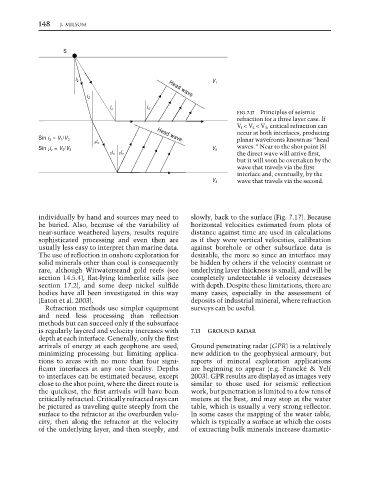
                                                                            FIG. 7.17 Principles of seismic
                                                                            refraction for a three layer case. lf
                                                                            V l < V 2 < V 3 , critical refraction can
                                                                            occur at both interfaces, producing
                                                                            planar wavefronts known as “head
                                                    Head wave
                  Sin i 3  = V 1 /V 3
                                  2 i c
                                                                            waves.” Near to the shot point (S)
                  Sin  2 i c  = V 2 /V 3                            V 2
                                       2 i c  2 i c                         the direct wave will arrive first,
                                                                            but it will soon be overtaken by the
                                                                            wave that travels via the first
                                                                            interface and, eventually, by the
                                                                            wave that travels via the second.
                                                                    V 3

                  individually by hand and sources may need to  slowly, back to the surface (Fig. 7.17). Because
                  be buried. Also, because of the variability of  horizontal velocities estimated from plots of
                  near-surface weathered layers, results require  distance against time are used in calculations
                  sophisticated processing and even then are  as if they were vertical velocities, calibration
                  usually less easy to interpret than marine data.  against borehole or other subsurface data is
                  The use of reflection in onshore exploration for  desirable, the more so since an interface may
                  solid minerals other than coal is consequently  be hidden by others if the velocity contrast or
                  rare, although Witwatersrand gold reefs (see  underlying layer thickness is small, and will be
                  section 14.5.4), flat-lying kimberlite sills (see  completely undetectable if velocity decreases
                  section 17.2), and some deep nickel sulfide  with depth. Despite these limitations, there are
                  bodies have all been investigated in this way  many cases, especially in the assessment of
                  (Eaton et al. 2003).                        deposits of industrial mineral, where refraction
                    Refraction methods use simpler equipment  surveys can be useful.
                  and need less processing than reflection
                  methods but can succeed only if the subsurface
                  is regularly layered and velocity increases with  7.13  GROUND RADAR
                  depth at each interface. Generally, only the first
                  arrivals of energy at each geophone are used,  Ground penetrating radar (GPR) is a relatively
                  minimizing processing but limiting applica-  new addition to the geophysical armoury, but
                  tions to areas with no more than four signi-  reports of mineral exploration applications
                  ficant interfaces at any one locality. Depths  are beginning to appear (e.g. Francké & Yelf
                  to interfaces can be estimated because, except  2003). GPR results are displayed as images very
                  close to the shot point, where the direct route is  similar to those used for seismic reflection
                  the quickest, the first arrivals will have been  work, but penetration is limited to a few tens of
                  critically refracted. Critically refracted rays can  meters at the best, and may stop at the water
                  be pictured as traveling quite steeply from the  table, which is usually a very strong reflector.
                  surface to the refractor at the overburden velo-  In some cases the mapping of the water table,
                  city, then along the refractor at the velocity  which is typically a surface at which the costs
                  of the underlying layer, and then steeply, and  of extracting bulk minerals increase dramatic-

