


Page 161 - Introduction to Mineral Exploration
P. 161
144   J. MILSOM


                              Skin depth = 500  ρ /f
                     500
                     300                1250 Hz     20 kHz  80 kHz
                   Skin depth (m)  100        5 kHz

                     50
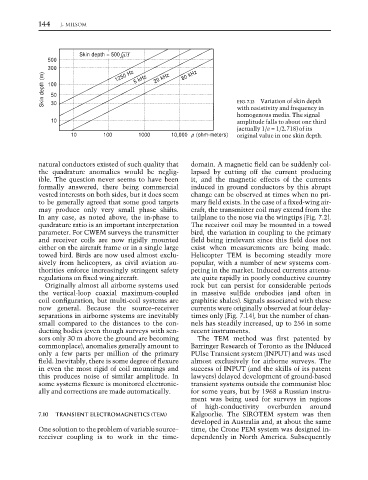
                                                                                  Variation of skin depth
                                                                            FIG. 7.13
                     30
                                                                            with resistivity and frequency in
                                                                            homogenous media. The signal
                     10                                                     amplitude falls to about one third
                                                                            (actually 1/e = 1/2.718) of its
                                                              ρ
                           10        100       1000     10,000 ρ (ohm-meters)  original value in one skin depth.


                  natural conductors existed of such quality that  domain. A magnetic field can be suddenly col-
                  the quadrature anomalies would be neglig-   lapsed by cutting off the current producing
                  ible. The question never seems to have been  it, and the magnetic effects of the currents
                  formally answered, there being commercial   induced in ground conductors by this abrupt
                  vested interests on both sides, but it does seem  change can be observed at times when no pri-
                  to be generally agreed that some good targets  mary field exists. In the case of a fixed-wing air-
                  may produce only very small phase shifts.   craft, the transmitter coil may extend from the
                  In any case, as noted above, the in-phase to  tailplane to the nose via the wingtips (Fig. 7.2).
                  quadrature ratio is an important interpretation  The receiver coil may be mounted in a towed
                  parameter. For CWEM surveys the transmitter  bird, the variation in coupling to the primary
                  and receiver coils are now rigidly mounted  field being irrelevant since this field does not
                  either on the aircraft frame or in a single large  exist when measurements are being made.
                  towed bird. Birds are now used almost exclu-  Helicopter TEM is becoming steadily more
                  sively from helicopters, as civil aviation au-  popular, with a number of new systems com-
                  thorities enforce increasingly stringent safety  peting in the market. Induced currents attenu-
                  regulations on fixed wing aircraft.          ate quite rapidly in poorly conductive country
                    Originally almost all airborne systems used  rock but can persist for considerable periods
                  the vertical-loop coaxial maximum-coupled   in massive sulfide orebodies (and often in
                  coil configuration, but multi-coil systems are  graphitic shales). Signals associated with these
                  now general. Because the source–receiver    currents were originally observed at four delay-
                  separations in airborne systems are inevitably  times only (Fig. 7.14), but the number of chan-
                  small compared to the distances to the con-  nels has steadily increased, up to 256 in some
                  ducting bodies (even though surveys with sen-  recent instruments.
                  sors only 30 m above the ground are becoming  The TEM method was first patented by
                  commonplace), anomalies generally amount to  Barringer Research of Toronto as the INduced
                  only a few parts per million of the primary  PUlse Transient system (INPUT) and was used
                  field. Inevitably, there is some degree of flexure  almost exclusively for airborne surveys. The
                  in even the most rigid of coil mountings and  success of INPUT (and the skills of its patent
                  this produces noise of similar amplitude. In  lawyers) delayed development of ground-based
                  some systems flexure is monitored electronic-  transient systems outside the communist bloc
                  ally and corrections are made automatically.  for some years, but by 1968 a Russian instru-
                                                              ment was being used for surveys in regions
                                                              of  high-conductivity  overburden  around
                  7.10  TRANSIENT ELECTROMAGNETICS (TEM)      Kalgoorlie. The SIROTEM system was then
                                                              developed in Australia and, at about the same
                  One solution to the problem of variable source–  time, the Crone PEM system was designed in-
                  receiver coupling is to work in the time-   dependently in North America. Subsequently

