


Page 166 - Introduction to Mineral Exploration
P. 166
7: GEOPHYSICAL METHODS  149


                   metres
                  16

                  8


                  0
                          A                                                                        A’
                  –8              50              100              150               200          meters

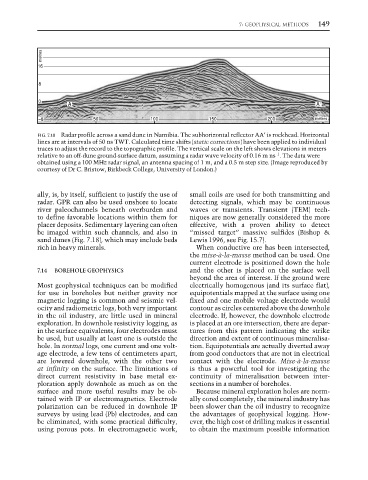
                 FIG. 7.18  Radar profile across a sand dune in Namibia. The subhorizontal reflector AA′ is rockhead. Horizontal
                 lines are at intervals of 50 ns TWT. Calculated time shifts (static corrections) have been applied to individual
                 traces to adjust the record to the topographic profile. The vertical scale on the left shows elevations in meters
                                                                                       −1
                 relative to an off-dune ground-surface datum, assuming a radar wave velocity of 0.16 m ns . The data were
                 obtained using a 100 MHz radar signal, an antenna spacing of 1 m, and a 0.5 m step size. (Image reproduced by
                 courtesy of Dr C. Bristow, Birkbeck College, University of London.)


                 ally, is, by itself, sufficient to justify the use of  small coils are used for both transmitting and
                 radar. GPR can also be used onshore to locate  detecting signals, which may be continuous
                 river paleochannels beneath overburden and   waves or transients. Transient (TEM) tech-
                 to define favorable locations within them for  niques are now generally considered the more
                 placer deposits. Sedimentary layering can often  effective, with a proven ability to detect
                 be imaged within such channels, and also in  “missed target” massive sulfides (Bishop &
                 sand dunes (Fig. 7.18), which may include beds  Lewis 1996, see Fig. 15.7).
                 rich in heavy minerals.                        When conductive ore has been intersected,
                                                              the mise-à-la-masse method can be used. One
                                                              current electrode is positioned down the hole
                 7.14  BOREHOLE GEOPHYSICS                    and the other is placed on the surface well
                                                              beyond the area of interest. If the ground were
                 Most geophysical techniques can be modified   electrically homogenous (and its surface flat),
                 for use in boreholes but neither gravity nor  equipotentials mapped at the surface using one
                 magnetic logging is common and seismic vel-  fixed and one mobile voltage electrode would
                 ocity and radiometric logs, both very important  contour as circles centered above the downhole
                 in the oil industry, are little used in mineral  electrode. If, however, the downhole electrode
                 exploration. In downhole resistivity logging, as  is placed at an ore intersection, there are depar-
                 in the surface equivalents, four electrodes must  tures from this pattern indicating the strike
                 be used, but usually at least one is outside the  direction and extent of continuous mineralisa-
                 hole. In normal logs, one current and one volt-  tion. Equipotentials are actually diverted away
                 age electrode, a few tens of centimeters apart,  from good conductors that are not in electrical
                 are lowered downhole, with the other two     contact with the electrode.  Mise-à-la-masse
                 at infinity on the surface. The  limitations  of  is thus a powerful tool for investigating the
                 direct current resistivity in base metal ex-  continuity of mineralisation between inter-
                 ploration apply downhole as much as on the   sections in a number of boreholes.
                 surface and more useful results may be ob-     Because mineral exploration holes are norm-
                 tained with IP or electromagnetics. Electrode  ally cored completely, the mineral industry has
                 polarization can be reduced in downhole IP   been slower than the oil industry to recognize
                 surveys by using lead (Pb) electrodes, and can  the advantages of geophysical logging. How-
                 be eliminated, with some practical difficulty,  ever, the high cost of drilling makes it essential
                 using porous pots. In electromagnetic work,  to obtain the maximum possible information

