


Page 164 - Introduction to Mineral Exploration
P. 164
7: GEOPHYSICAL METHODS  147


                 10

                                                                              D       S
                  20                                                                              B


                  30

                                       M
                  40


                  50


                  60


                 70


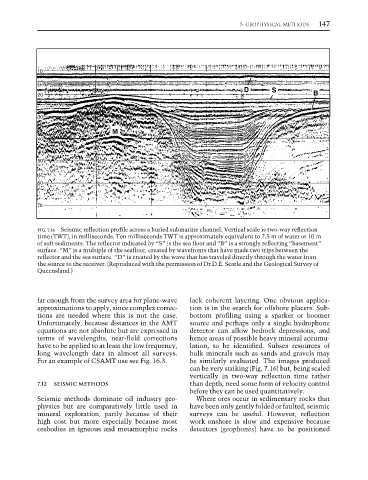
                 FIG. 7.16 Seismic reflection profile across a buried submarine channel. Vertical scale is two-way reflection
                 time (TWT), in milliseconds. Ten milliseconds TWT is approximately equivalent to 7.5 m of water or 10 m
                 of soft sediments. The reflector indicated by “S” is the sea floor and “B” is a strongly reflecting “basement”
                 surface. “M” is a multiple of the seafloor, created by wavefronts that have made two trips between the
                 reflector and the sea surface. “D” is created by the wave that has traveled directly through the water from
                 the source to the receiver. (Reproduced with the permission of Dr D.E. Searle and the Geological Survey of
                 Queensland.)


                 far enough from the survey area for plane-wave  lack coherent layering. One obvious applica-
                 approximations to apply, since complex correc-  tion is in the search for offshore placers. Sub-
                 tions are needed where this is not the case.  bottom profiling using a sparker or boomer
                 Unfortunately, because distances in the AMT  source and perhaps only a single hydrophone
                 equations are not absolute but are expressed in  detector can allow bedrock depressions, and
                 terms of wavelengths, near-field corrections  hence areas of possible heavy mineral accumu-
                 have to be applied to at least the low frequency,  lation, to be identified. Subsea resources of
                 long wavelength data in almost all surveys.  bulk minerals such as sands and gravels may
                 For an example of CSAMT use see Fig. 16.3.   be similarly evaluated. The images produced
                                                              can be very striking (Fig. 7.16) but, being scaled
                                                              vertically in two-way reflection time rather
                 7.12  SEISMIC METHODS                        than depth, need some form of velocity control
                                                              before they can be used quantitatively.
                 Seismic methods dominate oil industry geo-     Where ores occur in sedimentary rocks that
                 physics but are comparatively little used in  have been only gently folded or faulted, seismic
                 mineral exploration, partly because of their  surveys can be useful. However, reflection
                 high cost but more especially because most   work onshore is slow and expensive because
                 orebodies in igneous and metamorphic rocks   detectors (geophones)  have to be positioned

