


Page 156 - Introduction to Mineral Exploration
P. 156
7: GEOPHYSICAL METHODS  139


                                                                         Schlumberger: L/h
                                                              k = 1.0           0.9               0.8

                                                    ρ
                                                    ρ 2  – ρ 1 ρ
                                                  k =  ρ                                          0.7
                                                    ρ 2  + ρ 1 ρ
                       Schlumberger
                         “cross”                                                                  0.6
                                    Wenner                                                        0.5
                                    “cross”
                                                                                                  0.4
                                                                                                  0.3
                                                                                                  0.2
                      ρ α α ρ                                                                     0.1
                      ρ α  / ρ 1  = 1
                   ρ α /ρ 1 ρρ  α                                                                 0.0
                                                                                                 −0.1
                                                                                                 −0.2
                                                                                                 −0.3
                                                                                                 −0.4
                       “Cross” for Wenner                                                        −0.5
                        or Schlumberger
                        field curve plotted                                                      −0.6
                        using total array  L/h = 1 (Schlumberger)  a/h = 1 (Wenner)
                         length (2L) as                                                          −0.7
                           ordinate               k = −1.0            L/h = 10  a/h = 10

                                                              −0.9
                                                                Wenner: a/h (= 2L/3h)            −0.8
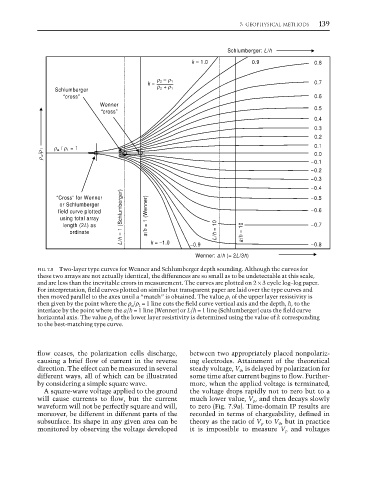
                 FIG. 7.8  Two-layer type curves for Wenner and Schlumberger depth sounding. Although the curves for
                 these two arrays are not actually identical, the differences are so small as to be undetectable at this scale,
                 and are less than the inevitable errors in measurement. The curves are plotted on 2 × 3 cycle log–log paper.
                 For interpretation, field curves plotted on similar but transparent paper are laid over the type curves and
                 then moved parallel to the axes until a “match” is obtained. The value ρ 1  of the upper layer resistivity is
                 then given by the point where the ρ a /ρ 1  = 1 line cuts the field curve vertical axis and the depth, h, to the
                 interface by the point where the a/h = 1 line (Wenner) or L/h = 1 line (Schlumberger) cuts the field curve
                 horizontal axis. The value ρ 2  of the lower layer resistivity is determined using the value of k corresponding
                 to the best-matching type curve.


                 flow ceases, the polarization cells discharge,  between two appropriately placed nonpolariz-
                 causing a brief flow of current in the reverse  ing electrodes. Attainment of the theoretical
                 direction. The effect can be measured in several  steady voltage, V 0 , is delayed by polarization for
                 different ways, all of which can be illustrated  some time after current begins to flow. Further-
                 by considering a simple square wave.         more, when the applied voltage is terminated,
                   A square-wave voltage applied to the ground  the voltage drops rapidly not to zero but to a
                 will cause currents to flow, but the current  much lower value, V p , and then decays slowly
                 waveform will not be perfectly square and will,  to zero (Fig. 7.9a). Time-domain IP results are
                 moreover, be different in different parts of the  recorded in terms of chargeability, defined in
                 subsurface. Its shape in any given area can be  theory as the ratio of V p  to V 0 , but in practice
                 monitored by observing the voltage developed  it is impossible to measure  V p  and voltages

