


Page 158 - Introduction to Mineral Exploration
P. 158
7: GEOPHYSICAL METHODS  141


                                                               n = 1  n = 2  n = 3         Near-surface
                                                                                         chargeable material
                                                      I         V 1  V 2  V 3


                                                     n = 1  09  06   18   66   66   07   07
                                                       n = 2  03  20   69   49    61   04   09
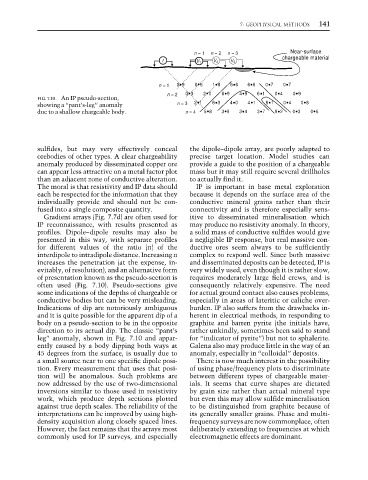
                 FIG. 7.10 An IP pseudo-section,
                 showing a “pant’s-leg” anomaly           n = 3  21  63   40   41   81   04   08
                 due to a shallow chargeable body.           n = 4  58  39  34    37   92   03   06


                 sulfides, but may very effectively conceal    the dipole–dipole array, are poorly adapted to
                 orebodies of other types. A clear chargeability  precise target location. Model studies can
                 anomaly produced by disseminated copper ore  provide a guide to the position of a chargeable
                 can appear less attractive on a metal factor plot  mass but it may still require several drillholes
                 than an adjacent zone of conductive alteration.  to actually find it.
                 The moral is that resistivity and IP data should  IP is important in base metal exploration
                 each be respected for the information that they  because it depends on the surface area of the
                 individually provide and should not be con-  conductive mineral grains rather than their
                 fused into a single composite quantity.      connectivity and is therefore especially sens-
                   Gradient arrays (Fig. 7.7d) are often used for  itive to disseminated mineralisation which
                 IP reconnaissance, with results presented as  may produce no resistivity anomaly. In theory,
                 profiles. Dipole–dipole results may also be   a solid mass of conductive sulfides would give
                 presented in this way, with separate profiles  a negligible IP response, but real massive con-
                 for different values of the ratio (n) of the  ductive ores seem always to be sufficiently
                 interdipole to intradipole distance. Increasing n  complex to respond well. Since both massive
                 increases the penetration (at the expense, in-  and disseminated deposits can be detected, IP is
                 evitably, of resolution), and an alternative form  very widely used, even though it is rather slow,
                 of presentation known as the pseudo-section is  requires moderately large field crews, and is
                 often used (Fig. 7.10). Pseudo-sections give  consequently relatively expensive. The need
                 some indications of the depths of chargeable or  for actual ground contact also causes problems,
                 conductive bodies but can be very misleading.  especially in areas of lateritic or caliche over-
                 Indications of dip are notoriously ambiguous  burden. IP also suffers from the drawbacks in-
                 and it is quite possible for the apparent dip of a  herent in electrical methods, in responding to
                 body on a pseudo-section to be in the opposite  graphite and barren pyrite (the initials have,
                 direction to its actual dip. The classic “pant’s  rather unkindly, sometimes been said to stand
                 leg” anomaly, shown in Fig. 7.10 and appar-  for “indicator of pyrite”) but not to sphalerite.
                 ently caused by a body dipping both ways at  Galena also may produce little in the way of an
                 45 degrees from the surface, is usually due to  anomaly, especially in “colloidal” deposits.
                 a small source near to one specific dipole posi-  There is now much interest in the possibility
                 tion. Every measurement that uses that posi-  of using phase/frequency plots to discriminate
                 tion will be anomalous. Such problems are    between different types of chargeable mater-
                 now addressed by the use of two-dimensional  ials. It seems that curve shapes are dictated
                 inversions similar to those used in resistivity  by grain size rather than actual mineral type
                 work, which produce depth sections plotted   but even this may allow sulfide mineralisation
                 against true depth scales. The reliability of the  to be distinguished from graphite because of
                 interpretations can be improved by using high-  its generally smaller grains. Phase and multi-
                 density acquisition along closely spaced lines.  frequency surveys are now commonplace, often
                 However, the fact remains that the arrays most  deliberately extending to frequencies at which
                 commonly used for IP surveys, and especially  electromagnetic effects are dominant.

