


Page 157 - Introduction to Mineral Exploration
P. 157
140   J. MILSOM


                                                            ρ    ρ  ρ
                                                  PFE = 100 × (ρ d.c.  – ρ h.f. )/ρ h.f.
                       V p                            = 100 × V p /(V o  − V p )
                                  M = V p /V o

                    V o
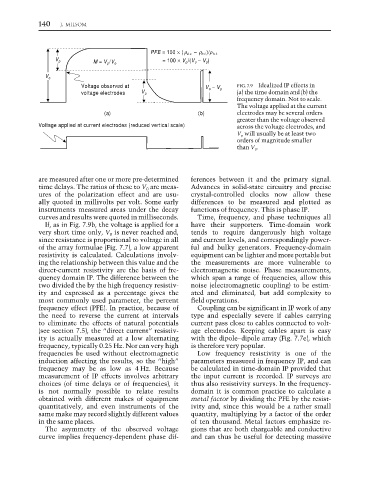
                              Voltage observed at                           FIG. 7.9 Idealized IP effects in
                                                                  V o  − V p
                              voltage electrodes  V p                       (a) the time domain and (b) the
                                                                            frequency domain. Not to scale.
                                                                            The voltage applied at the current
                                     (a)                        (b)         electrodes may be several orders
                                                                            greater than the voltage observed
                  Voltage applied at current electrodes (reduced vertical scale)  across the voltage electrodes, and
                                                                            V p  will usually be at least two
                                                                            orders of magnitude smaller
                                                                            than V 0 .


                  are measured after one or more pre-determined  ferences between it and the primary signal.
                  time delays. The ratios of these to V 0  are meas-  Advances in solid-state circuitry and precise
                  ures of the polarization effect and are usu-  crystal-controlled clocks now allow these
                  ally quoted in millivolts per volt. Some early  differences to be measured and plotted as
                  instruments measured areas under the decay  functions of frequency. This is phase IP.
                  curves and results were quoted in milliseconds.  Time, frequency, and phase techniques all
                    If, as in Fig. 7.9b, the voltage is applied for a  have their supporters. Time-domain work
                  very short time only, V 0  is never reached and,  tends to require dangerously high voltage
                  since resistance is proportional to voltage in all  and current levels, and correspondingly power-
                  of the array formulae (Fig. 7.7), a low apparent  ful and bulky generators. Frequency-domain
                  resistivity is calculated. Calculations involv-  equipment can be lighter and more portable but
                  ing the relationship between this value and the  the measurements are more vulnerable to
                  direct-current  resistivity are the basis of fre-  electromagnetic noise. Phase measurements,
                  quency domain IP. The difference between the  which span a range of frequencies, allow this
                  two divided the by the high frequency resistiv-  noise (electromagnetic coupling) to be estim-
                  ity and expressed as a percentage gives the  ated and eliminated, but add complexity to
                  most commonly used parameter, the percent   field operations.
                  frequency effect (PFE). In practice, because of  Coupling can be significant in IP work of any
                  the need to reverse the current at intervals  type and especially severe if cables carrying
                  to eliminate the effects of natural potentials  current pass close to cables connected to volt-
                  (see section 7.5), the “direct current” resistiv-  age electrodes. Keeping cables apart is easy
                  ity is actually measured at a low alternating  with the dipole–dipole array (Fig. 7.7e), which
                  frequency, typically 0.25 Hz. Nor can very high  is therefore very popular.
                  frequencies be used without electromagnetic   Low frequency resistivity is one of the
                  induction affecting the results, so the “high”  parameters measured in frequency IP, and can
                  frequency may be as low as 4 Hz. Because    be calculated in time-domain IP provided that
                  measurement of IP effects involves arbitrary  the input current is recorded. IP surveys are
                  choices (of time delays or of frequencies), it  thus also resistivity surveys. In the frequency-
                  is not normally possible to relate results  domain it is common practice to calculate a
                  obtained with different makes of equipment  metal factor by dividing the PFE by the resist-
                  quantitatively, and even instruments of the  ivity and, since this would be a rather small
                  same make may record slightly different values  quantity, multiplying by a factor of the order
                  in the same places.                         of ten thousand. Metal factors emphasize re-
                    The asymmetry of the observed voltage     gions that are both chargeable and conductive
                  curve implies frequency-dependent phase dif-  and can thus be useful for detecting massive

