


Page 250 - Introduction to Mineral Exploration
P. 250
10: EVALUATION TECHNIQUES  233


                 (a)
                     160
                     140          Cut-off grade                             Cut-off grade
                     120
                   Tonnage  100                                   Waste            Ore correctly
                      80
                                                                  misclassified
                      60                                          as ore           classified
                      40                                       Estimated grade
                      20
                      0                                                                      Cut-off grade
                       0.0  0.2  0.4  0.6  0.8  1.0  1.2  1.4
                                     Grade (%)
                                                                  Waste                Ore misclassified
                 (b)                                              correctly            as waste
                    1200           Cut-off grade                  classified   Actual grade
                    1000
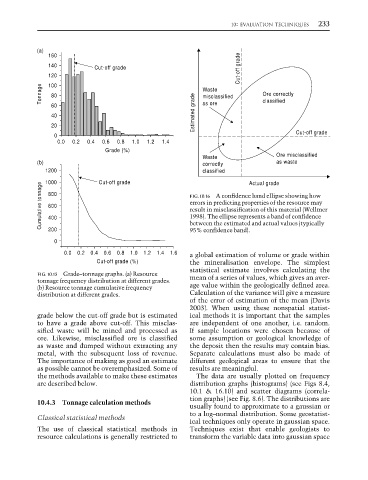
                   Cumulative tonnage  800                    FIG. 10.16 A confidence band ellipse showing how

                                                              errors in predicting properties of the resource may
                     600
                                                              result in misclassification of this material (Wellmer
                                                              1998). The ellipse represents a band of confidence
                     400
                     200
                                                              95% confidence band).
                      0                                       between the estimated and actual values (typically
                         0.0  0.2  0.4  0.6  0.8  1.0  1.2  1.4  1.6  a global estimation of volume or grade within
                                   Cut-off grade (%)          the mineralisation envelope. The simplest
                                                              statistical estimate involves calculating the
                 FIG. 10.15  Grade–tonnage graphs. (a) Resource  mean of a series of values, which gives an aver-
                 tonnage frequency distribution at different grades.
                 (b) Resource tonnage cumulative frequency    age value within the geologically defined area.
                 distribution at different grades.            Calculation of the variance will give a measure
                                                              of the error of estimation of the mean (Davis
                                                              2003). When using these nonspatial statist-
                 grade below the cut-off grade but is estimated  ical methods it is important that the samples
                 to have a grade above cut-off. This misclas-  are independent of one another, i.e. random.
                 sified waste will be mined and processed as   If sample locations were chosen because of
                 ore. Likewise, misclassified ore is classified  some assumption or geological knowledge of
                 as waste and dumped without extracting any   the deposit then the results may contain bias.
                 metal, with the subsequent loss of revenue.  Separate calculations must also be made of
                 The importance of making as good an estimate  different geological areas to ensure that the
                 as possible cannot be overemphasized. Some of  results are meaningful.
                 the methods available to make these estimates  The data are usually plotted on frequency
                 are described below.                         distribution graphs (histograms) (see Figs 8.4,
                                                              10.1 & 16.10) and scatter diagrams (correla-
                                                              tion graphs) (see Fig. 8.6). The distributions are
                 10.4.3  Tonnage calculation methods
                                                              usually found to approximate to a gaussian or
                                                              to a log–normal distribution. Some geostatist-
                 Classical statistical methods
                                                              ical techniques only operate in gaussian space.
                 The use of classical statistical methods in  Techniques exist that enable geologists to
                 resource calculations is generally restricted to  transform the variable data into gaussian space

