


Page 253 - Introduction to Mineral Exploration
P. 253
236   M.K.G. WHATELEY & B. SCOTT


                  BOX 10.4  Calculating the semi-variogram.

                    It is assumed that the variability between two samples depends upon the distance between them and
                    their relative orientation. By definition this variability (semi-variance or γ (h)) is represented as half the
                    average squared difference between samples that are a given separation or lag distance (h) apart (see the
                    equation below).
                      In the example (Fig. 10.18), the sample grid shows thickness values of a stratiform mineral deposit or
                    coal seam at 100 m centers. Suppose we call this distance between the samples (in the first instance
                    100 m) and their orientation, h. We can calculate the semi-variance from the difference between samples
                    at different distances (lags) and in different orientations, e.g. at 200 m (Fig. 10.22) and 300 m (Fig. 10.23),
                    etc. These examples are all shown with an E–W orientation, but the principle equally applies with N–S,
                    NE–SW, etc. directions. We calculate the semi-variance of the distances for as many different values of h
                    as possible using the following formula:
                                                          nh
                                                          ()
                                                         ∑ (z −  z (z h ) )  2
                                                                  −
                                                             ()
                                                             i
                                                        =
                                                    γ ()    i=1
                                                      h
                                                               ()
                                                             2 nh
                    where γ (h) = semi-variance, n(h) = number of pairs used in the calculation, z = grade, thickness, or
                    whatever, (i) = the position of one sample in the pair, (i+h) = the position of the other sample in the pair,
                    h meters away from z(i).
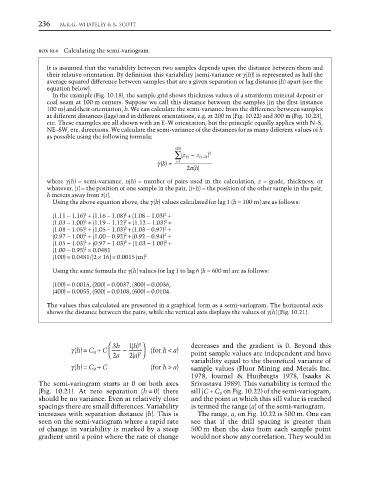
                      Using the above equation above, the γ (h) values calculated for lag 1 (h = 100 m) are as follows:
                      (1.11 − 1.16) + (1.16 − 1.08) + (1.08 − 1.03) +
                                           2
                                                      2
                               2
                      (1.03 − 1.00) + (1.19 − 1.12) + (1.12 − 1.03) +
                                                       2
                                           2
                               2
                      (1.08 − 1.05) + (1.05 − 1.03) + (1.03 − 0.97) +
                                           2
                               2
                                                      2
                      (0.97 − 1.00) + (1.00 − 0.92) + (0.92 − 0.94) +
                               2
                                           2
                                                      2
                      (1.05 − 1.03) + (0.97 − 1.03) + (1.03 − 1.00) +
                                                       2
                                           2
                               2
                               2
                      (1.00 − 0.95) = 0.0481
                      (100) = 0.0481/[2 × 16] = 0.0015 (m) 2
                      Using the same formula the γ (h) values for lag 1 to lag 6 (h = 600 m) are as follows:
                      (100) = 0.0015, (200) = 0.0037, (300) = 0.0036,
                      (400) = 0.0055, (500) = 0.0108, (600) = 0.0104.
                    The values thus calculated are presented in a graphical form as a semi-variogram. The horizontal axis
                    shows the distance between the pairs, while the vertical axis displays the values of γ (h) (Fig. 10.21).
                                      ⎛  3h  1h () ⎞          decreases and the gradient is 0. Beyond this
                                               3
                                               3 ⎟
                           γ (h) = C 0  + C  ⎜ ⎝     −  2a () ⎠  (for h < a)  point sample values are independent and have
                                             2a               variability equal to the theoretical variance of
                           γ (h) = C 0  + C        (for h > a)  sample values (Fluor Mining and Metals Inc.
                                                              1978, Journel & Huijbregts 1978, Isaaks &
                  The semi-variogram starts at 0 on both axes  Srivastava 1989). This variability is termed the
                  (Fig. 10.21). At zero separation (h = 0) there  sill (C + C 0  on Fig. 10.22) of the semi-variogram,
                  should be no variance. Even at relatively close  and the point at which this sill value is reached
                  spacings there are small differences. Variability  is termed the range (a) of the semi-variogram.
                  increases with separation distance (h). This is  The range, a, on Fig. 10.22 is 500 m. One can
                  seen on the semi-variogram where a rapid rate  see that if the drill spacing is greater than
                  of change in variability is marked by a steep  500 m then the data from each sample point
                  gradient until a point where the rate of change  would not show any correlation. They would in

