


Page 258 - Introduction to Mineral Exploration
P. 258
10: EVALUATION TECHNIQUES  241


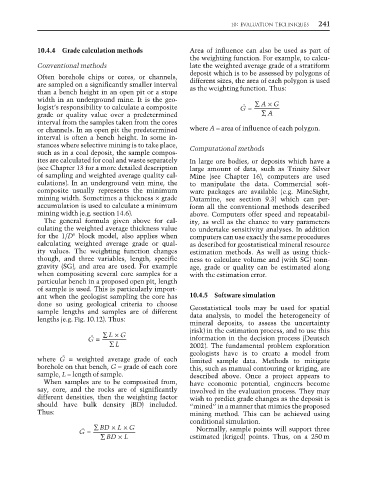
                 10.4.4  Grade calculation methods            Area of influence can also be used as part of
                                                              the weighting function. For example, to calcu-
                 Conventional methods                         late the weighted average grade of a stratiform
                                                              deposit which is to be assessed by polygons of
                 Often borehole chips or cores, or channels,  different sizes, the area of each polygon is used
                 are sampled on a significantly smaller interval  as the weighting function. Thus:
                 than a bench height in an open pit or a stope
                 width in an underground mine. It is the geo-                        ×
                                                                               =
                 logist’s responsibility to calculate a composite            G   ∑ A   G
                 grade or quality value over a predetermined                          ∑ A
                 interval from the samples taken from the cores
                 or channels. In an open pit the predetermined  where A = area of influence of each polygon.
                 interval is often a bench height. In some in-
                 stances where selective mining is to take place,  Computational methods
                 such as in a coal deposit, the sample compos-
                 ites are calculated for coal and waste separately  In large ore bodies, or deposits which have a
                 (see Chapter 13 for a more detailed description  large amount of data, such as Trinity Silver
                 of sampling and weighted average quality cal-  Mine (see Chapter 16), computers are used
                 culations). In an underground vein mine, the  to manipulate the data. Commercial soft-
                 composite usually represents the minimum     ware packages are available (e.g. MineSight,
                 mining width. Sometimes a thickness × grade  Datamine, see section 9.3) which can per-
                 accumulation is used to calculate a minimum  form all the conventional methods described
                 mining width (e.g. section 14.6).            above. Computers offer speed and repeatabil-
                   The general formula given above for cal-   ity, as well as the chance to vary parameters
                 culating the weighted average thickness value  to undertake sensitivity analyses. In addition
                            n
                 for the 1/D  block model, also applies when  computers can use exactly the same procedures
                 calculating weighted average grade or qual-  as described for geostatistical mineral resource
                 ity values. The weighting function changes   estimation methods. As well as using thick-
                 though, and three variables, length, specific  ness to calculate volume and (with SG) tonn-
                 gravity (SG), and area are used. For example  age, grade or quality can be estimated along
                 when compositing several core samples for a  with the estimation error.
                 particular bench in a proposed open pit, length
                 of sample is used. This is particularly import-
                 ant when the geologist sampling the core has  10.4.5  Software simulation
                 done so using geological criteria to choose  Geostatistical tools may be used for spatial
                 sample lengths and samples are of different  data analysis, to model the heterogeneity of
                 lengths (e.g. Fig. 10.12). Thus:
                                                              mineral deposits, to assess the uncertainty
                                        ×
                                     ∑ L   G                  (risk) in the estimation process, and to use this
                                   =
                                G                             information in the decision process (Deutsch
                                          ∑ L                 2002). The fundamental problem exploration
                                                              geologists have is to create a model from
                 where  G  = weighted average grade of each   limited sample data. Methods to mitigate
                 borehole on that bench, G = grade of each core  this, such as manual contouring or kriging, are
                 sample, L = length of sample.                described above. Once a project appears to
                   When samples are to be composited from,    have economic potential, engineers become
                 say, core, and the rocks are of significantly  involved in the evaluation process. They may
                 different densities, then the weighting factor  wish to predict grade changes as the deposit is
                 should have bulk density (BD) included.      “mined” in a manner that mimics the proposed
                 Thus:                                        mining method. This can be achieved using
                                                              conditional simulation.
                                           ×
                                       ×
                                  ∑ BD      G                   Normally, sample points will support three
                                         L
                                =
                              G
                                         ×
                                       ∑ BD   L               estimated (kriged) points. Thus, on a 250 m

