


Page 259 - Introduction to Mineral Exploration
P. 259
242   M.K.G. WHATELEY & B. SCOTT


                  drilling grid, block size would be 80 m.    sulfur or trace element data points (Whateley
                                                       −3
                  Mineralized rock with a density of 2.6 t m  in  2002). This creates estimation problems and
                  an 80 × 80 m block with a 15 m bench will   difficulties in estimating life of mine (LOM)
                  provide 250 kt of material. This is usually too  coal quality variability. This lack of data for
                  coarse to provide an estimate of local variab-  some of the layers within a model presents
                  ility. This is a situation where conditional  problems to the estimator for the application
                  simulation can be used because it allows the  of the method. This is particularly true for
                  estimator to generate values on a very fine grid.  sulfur values within some plies when less
                  All calculations are performed using gaussian  than 30 samples of hard data are available
                  transformed (normalized) data (Deutsch 2002).  for each layer. Adapting the conditional simu-
                  The properties of the resultant simulations  lation technique, by using the more abund-
                  are such that they replicate the statistical and  ant, but less reliable whole seam data (soft
                  geostatistical properties of the input data, as  data) to augment the ply data, can mitigate
                  well as honoring the input data. The simulated  this problem. Conditional simulation models
                  values are controlled, or conditioned, by drill-  thus generated still need to be carefully
                  hole samples, which gives rise to the name  examined and verified. Once they are found
                  of this technique (Deutsch & Journel 1998,  to satisfactorily replicate the geological, stat-
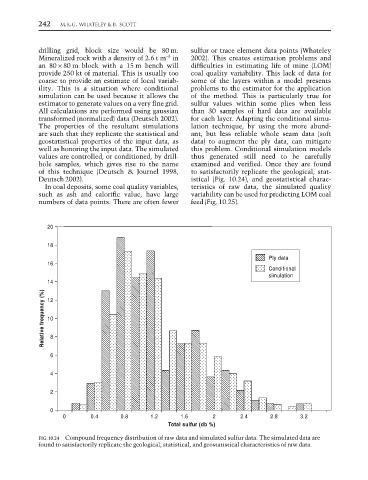
                  Deutsch 2002).                              istical (Fig. 10.24), and geostatistical charac-
                    In coal deposits, some coal quality variables,  teristics of raw data, the simulated quality
                  such as ash and calorific value, have large  variability can be used for predicting LOM coal
                  numbers of data points. There are often fewer  feed (Fig. 10.25).


                    20


                    18
                                                                                     Ply data
                    16
                                                                                     Conditional
                                                                                     simulation
                    14
                   Relative frequency (%)  12


                    10

                     8


                     6

                     4

                     2


                     0
                         0       0.4      0.8     1.2      1.6       2       2.4     2.8      3.2
                                                        Total sulfur (db %)
                  FIG. 10.24 Compound frequency distribution of raw data and simulated sulfur data. The simulated data are
                  found to satisfactorily replicate the geological, statistical, and geostatistical characteristics of raw data.

