


Page 263 - Introduction to Mineral Exploration
P. 263
246   M.K.G. WHATELEY & B. SCOTT


                                     Load                                     Axial stress
                  (a)                 σ                              (b)         σ 1
                                      σ 1


                                                 Seal                                        Shear fracture
                    Steel                                                      σ
                                                                               σ n
                   cylinder
                                                                                  θ
                                                                                                   σ
                                                                                                σ
                                                                   σ
                                                                σ
                   σ  σ                          Borehole core  σ 2 =σ 3      τ                 σ 2 =σ 3
                   σ 2 =σ 3
                  Confining                                                                    Confining
                  pressure                                                                      pressure
                                                 Flexible membrane
                  Fluid filled
                   chamber
                                                 Pressure from pump
                                                                                 σ 2
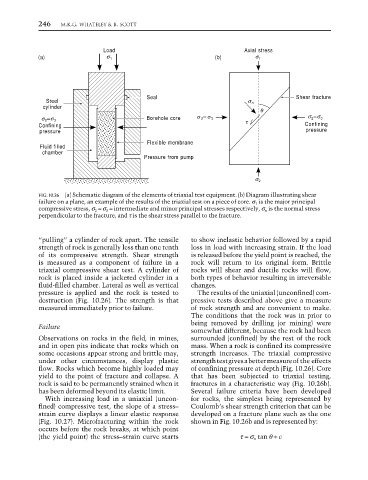
                  FIG. 10.26 (a) Schematic diagram of the elements of triaxial test equipment. (b) Diagram illustrating shear
                  failure on a plane, an example of the results of the triaxial test on a piece of core. σ 1  is the major principal
                  compressive stress, σ 2  = σ 3  = intermediate and minor principal stresses respectively, σ n  is the normal stress
                  perpendicular to the fracture, and τ is the shear stress parallel to the fracture.


                  “pulling” a cylinder of rock apart. The tensile  to show inelastic behavior followed by a rapid
                  strength of rock is generally less than one tenth  loss in load with increasing strain. If the load
                  of its compressive strength. Shear strength  is released before the yield point is reached, the
                  is measured as a component of failure in a  rock will return to its original form. Brittle
                  triaxial compressive shear test. A cylinder of  rocks will shear and ductile rocks will flow,
                  rock is placed inside a jacketed cylinder in a  both types of behavior resulting in irreversible
                  fluid-filled chamber. Lateral as well as vertical  changes.
                  pressure is applied and the rock is tested to  The results of the uniaxial (unconfined) com-
                  destruction (Fig. 10.26). The strength is that  pressive tests described above give a measure
                  measured immediately prior to failure.      of rock strength and are convenient to make.
                                                              The conditions that the rock was in prior to
                                                              being removed by drilling (or mining) were
                  Failure
                                                              somewhat different, because the rock had been
                  Observations on rocks in the field, in mines,  surrounded (confined) by the rest of the rock
                  and in open pits indicate that rocks which on  mass. When a rock is confined its compressive
                  some occasions appear strong and brittle may,  strength increases. The triaxial compressive
                  under other circumstances, display plastic  strength test gives a better measure of the effects
                  flow. Rocks which become highly loaded may   of confining pressure at depth (Fig. 10.26). Core
                  yield to the point of fracture and collapse. A  that has been subjected to triaxial testing,
                  rock is said to be permanently strained when it  fractures in a characteristic way (Fig. 10.26b).
                  has been deformed beyond its elastic limit.  Several failure criteria have been developed
                    With increasing load in a uniaxial (uncon-  for rocks, the simplest being represented by
                  fined) compressive test, the slope of a stress–  Coulomb’s shear strength criterion that can be
                  strain curve displays a linear elastic response  developed on a fracture plane such as the one
                  (Fig. 10.27). Microfracturing within the rock  shown in Fig. 10.26b and is represented by:
                  occurs before the rock breaks, at which point
                  (the yield point) the stress–strain curve starts          τ = σ n  tan θ + c

