


Page 266 - Introduction to Mineral Exploration
P. 266
10: EVALUATION TECHNIQUES  249


                                          Shaft
                                                                   Dewatering borehole
                                                   Ore body
                                                                                      Ground surface


                         Piezometer installed
                          to measure the
                          water table level
                                                                                     Original water table

                                          Drawdown
                             Piezometric surface
                         Cone of depression


                                            Intersecting cones                      Flow line
                                              of depression
                                                                    Equipotential line       Point of
                                                                                             discharge
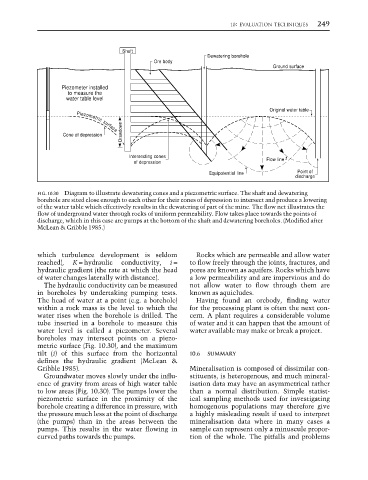
                 FIG. 10.30 Diagram to illustrate dewatering cones and a piezometric surface. The shaft and dewatering
                 borehole are sited close enough to each other for their cones of depression to intersect and produce a lowering
                 of the water table which effectively results in the dewatering of part of the mine. The flow net illustrates the
                 flow of underground water through rocks of uniform permeability. Flow takes place towards the points of
                 discharge, which in this case are pumps at the bottom of the shaft and dewatering boreholes. (Modified after
                 McLean & Gribble 1985.)


                 which turbulence development is seldom         Rocks which are permeable and allow water
                 reached),   K = hydraulic  conductivity,  i =  to flow freely through the joints, fractures, and
                 hydraulic gradient (the rate at which the head  pores are known as aquifers. Rocks which have
                 of water changes laterally with distance).   a low permeability and are impervious and do
                   The hydraulic conductivity can be measured  not allow water to flow through them are
                 in boreholes by undertaking pumping tests.   known as aquicludes.
                 The head of water at a point (e.g. a borehole)  Having found an orebody, finding water
                 within a rock mass is the level to which the  for the processing plant is often the next con-
                 water rises when the borehole is drilled. The  cern. A plant requires a considerable volume
                 tube inserted in a borehole to measure this  of water and it can happen that the amount of
                 water level is called a piezometer. Several  water available may make or break a project.
                 boreholes may intersect points on a piezo-
                 metric surface (Fig. 10.30), and the maximum
                 tilt (i) of this surface from the horizontal  10.6  SUMMARY
                 defines the hydraulic gradient (McLean &
                 Gribble 1985).                               Mineralisation is composed of dissimilar con-
                   Groundwater moves slowly under the influ-   stituents, is heterogenous, and much mineral-
                 ence of gravity from areas of high water table  isation data may have an asymmetrical rather
                 to low areas (Fig. 10.30). The pumps lower the  than a normal distribution. Simple statist-
                 piezometric surface in the proximity of the  ical sampling methods used for investigating
                 borehole creating a difference in pressure, with  homogenous populations may therefore give
                 the pressure much less at the point of discharge  a highly misleading result if used to interpret
                 (the pumps) than in the areas between the    mineralisation data where in many cases a
                 pumps. This results in the water flowing in   sample can represent only a minuscule propor-
                 curved paths towards the pumps.              tion of the whole. The pitfalls and problems

