


Page 265 - Introduction to Mineral Exploration
P. 265
248   M.K.G. WHATELEY & B. SCOTT


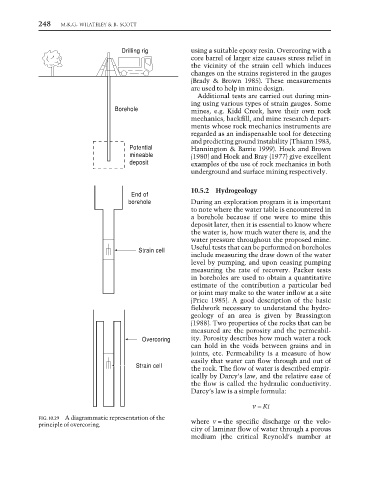
                                          Drilling rig        using a suitable epoxy resin. Overcoring with a
                                                              core barrel of larger size causes stress relief in
                                                              the vicinity of the strain cell which induces
                                                              changes on the strains registered in the gauges
                                                              (Brady & Brown 1985). These measurements
                                                              are used to help in mine design.
                                                                Additional tests are carried out during min-
                                                              ing using various types of strain gauges. Some
                                        Borehole              mines, e.g. Kidd Creek, have their own rock
                                                              mechanics, backfill, and mine research depart-
                                                              ments whose rock mechanics instruments are
                                                              regarded as an indispensable tool for detecting
                                                              and predicting ground instability (Thiann 1983,
                                            Potential         Hannington & Barrie 1999). Hoek and Brown
                                            mineable          (1980) and Hoek and Bray (1977) give excellent
                                            deposit           examples of the use of rock mechanics in both
                                                              underground and surface mining respectively.


                                                              10.5.2  Hydrogeology
                                             End of
                                            borehole          During an exploration program it is important
                                                              to note where the water table is encountered in
                                                              a borehole because if one were to mine this
                                                              deposit later, then it is essential to know where
                                                              the water is, how much water there is, and the
                                                              water pressure throughout the proposed mine.
                                                              Useful tests that can be performed on boreholes
                                               Strain cell
                                                              include measuring the draw down of the water
                                                              level by pumping, and upon ceasing pumping
                                                              measuring the rate of recovery. Packer tests
                                                              in boreholes are used to obtain a quantitative
                                                              estimate of the contribution a particular bed
                                                              or joint may make to the water inflow at a site
                                                              (Price 1985). A good description of the basic
                                                              fieldwork necessary to understand the hydro-
                                                              geology of an area is given by Brassington
                                                              (1988). Two properties of the rocks that can be
                                                              measured are the porosity and the permeabil-
                                                Overcoring    ity. Porosity describes how much water a rock
                                                              can hold in the voids between grains and in
                                                              joints, etc. Permeability is a measure of how
                                                              easily that water can flow through and out of
                                              Strain cell
                                                              the rock. The flow of water is described empir-
                                                              ically by Darcy’s law, and the relative ease of
                                                              the flow is called the hydraulic conductivity.
                                                              Darcy’s law is a simple formula:

                                                                                v = Ki
                  FIG. 10.29 A diagrammatic representation of the  where  v = the specific discharge or the velo-
                  principle of overcoring.
                                                              city of laminar flow of water through a porous
                                                              medium (the critical Reynold’s number at

