


Page 261 - Introduction to Mineral Exploration
P. 261
244   M.K.G. WHATELEY & B. SCOTT


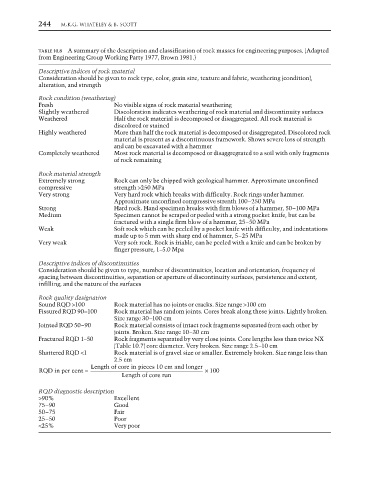
                  TABLE 10.8 A summary of the description and classification of rock masses for engineering purposes. (Adapted
                  from Engineering Group Working Party 1977, Brown 1981.)
                  Descriptive indices of rock material
                  Consideration should be given to rock type, color, grain size, texture and fabric, weathering (condition),
                  alteration, and strength

                  Rock condition (weathering)
                  Fresh                 No visible signs of rock material weathering
                  Slightly weathered    Discoloration indicates weathering of rock material and discontinuity surfaces
                  Weathered             Half the rock material is decomposed or disaggregated. All rock material is
                                        discolored or stained
                  Highly weathered      More than half the rock material is decomposed or disaggregated. Discolored rock
                                        material is present as a discontinuous framework. Shows severe loss of strength
                                        and can be excavated with a hammer
                  Completely weathered  Most rock material is decomposed or disaggregrated to a soil with only fragments
                                        of rock remaining

                  Rock material strength
                  Extremely strong      Rock can only be chipped with geological hammer. Approximate unconfined
                  compressive           strength >250 MPa
                  Very strong           Very hard rock which breaks with difficulty. Rock rings under hammer.
                                        Approximate unconfined compressive strenth 100–250 MPa
                  Strong                Hard rock. Hand specimen breaks with firm blows of a hammer, 50–100 MPa
                  Medium                Specimen cannot be scraped or peeled with a strong pocket knife, but can be
                                        fractured with a single firm blow of a hammer, 25–50 MPa
                  Weak                  Soft rock which can be peeled by a pocket knife with difficulty, and indentations
                                        made up to 5 mm with sharp end of hammer, 5–25 MPa
                  Very weak             Very soft rock. Rock is friable, can be peeled with a knife and can be broken by
                                        finger pressure, 1–5.0 Mpa

                  Descriptive indices of discontinuities
                  Consideration should be given to type, number of discontinuities, location and orientation, frequency of
                  spacing between discontinuities, separation or aperture of discontinuity surfaces, persistence and extent,
                  infilling, and the nature of the surfaces
                  Rock quality designation
                  Sound RQD >100        Rock material has no joints or cracks. Size range >100 cm
                  Fissured RQD 90–100   Rock material has random joints. Cores break along these joints. Lightly broken.
                                        Size range 30–100 cm
                  Jointed RQD 50–90     Rock material consists of intact rock fragments separated from each other by
                                        joints. Broken. Size range 10–30 cm
                  Fractured RQD 1–50    Rock fragments separated by very close joints. Core lengths less than twice NX
                                        (Table 10.7) core diameter. Very broken. Size range 2.5–10 cm
                  Shattered RQD <1      Rock material is of gravel size or smaller. Extremely broken. Size range less than
                                        2.5 cm
                                 Length of core in pieces 10 cm and longer
                  RQD in per cent =                               ×  100
                                          Length of core run
                  RQD diagnostic description
                  >90%                  Excellent
                  75–90                 Good
                  50–75                 Fair
                  25–50                 Poor
                  <25%                  Very poor

