


Page 256 - Introduction to Mineral Exploration
P. 256
10: EVALUATION TECHNIQUES  239


                 γ γ (h)                                      capable of producing a measurement of the
                                                              expected error of the estimate (see kriging vari-
                                                              ance below). The principles of kriging and types
                         Range (a) N–S
                                                              of kriging are discussed by Clark (1979), Journel
                    Range(a)E–W
                                                              and Huijbregts (1978), David (1988), Isaaks and
                                                              Srivastava (1989), Annels (1991), and Deutsch
                                                              (2002) amongst others. The kriging weights are
                                                              calculated such that they minimize estimation
                                                              variance by making extensive use of the semi-
                                                              variogram. The kriging estimator can be con-
                                                              sidered as unbiased under the constraint that
                                                              the sum of the weights is one. These weights
                                                              are then used to estimate the values of thick-
                                                              ness, elevation, grade, etc. for a series of blocks.
                                                         h      Kriging gives more weight to closer samples
                  0  100  200  300  400  500  600
                                                              than more distant ones, it addresses clustering,
                                Distance (m)                  continuity and anisotropy are considered, the
                                                              geometry of the data points and the character
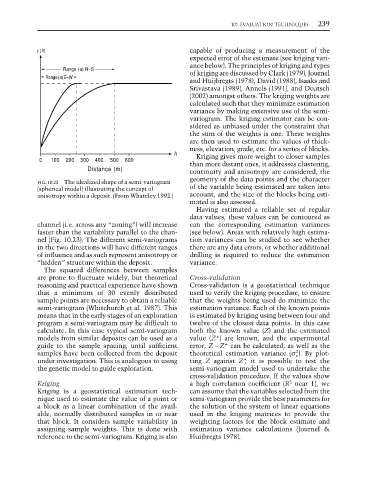
                 FIG. 10.23 The idealized shape of a semi-variogram
                 (spherical model) illustrating the concept of  of the variable being estimated are taken into
                 anisotropy within a deposit. (From Whateley 1992.)  account, and the size of the blocks being esti-
                                                              mated is also assessed.
                                                                Having estimated a reliable set of regular
                                                              data values, these values can be contoured as
                 channel (i.e. across any “zoning”) will increase  can the corresponding estimation variances
                 faster than the variability parallel to the chan-  (see below). Areas with relatively high estima-
                 nel (Fig. 10.23). The different semi-variograms  tion variances can be studied to see whether
                 in the two directions will have different ranges  there are any data errors, or whether additional
                 of influence and as such represent anisotropy or  drilling is required to reduce the estimation
                 “hidden” structure within the deposit.       variance.
                   The squared differences between samples
                 are prone to fluctuate widely, but theoretical  Cross-validation
                 reasoning and practical experience have shown  Cross-validation is a geostatistical technique
                 that a minimum of 30 evenly distributed      used to verify the kriging procedure, to ensure
                 sample points are necessary to obtain a reliable  that the weights being used do minimize the
                 semi-variogram (Whitchurch et al. 1987). This  estimation variance. Each of the known points
                 means that in the early stages of an exploration  is estimated by kriging using between four and
                 program a semi-variogram may be difficult to  twelve of the closest data points. In this case
                 calculate. In this case typical semi-variogram  both the known value (Z) and the estimated
                 models from similar deposits can be used as a  value (Z*) are known, and the experimental
                 guide to the sample spacing, until sufficient  error, Z–Z* can be calculated, as well as the
                                                                                             2
                 samples have been collected from the deposit  theoretical estimation variance (σ e ). By plot-
                 under investigation. This is analogous to using  ting  Z against  Z ,* it is possible to test the
                 the genetic model to guide exploration.      semi-variogram model used to undertake the
                                                              cross-validation procedure. If the values show
                                                                                           2
                 Kriging                                      a high correlation coefficient (R  near 1), we
                 Kriging is a geostatistical estimation tech-  can assume that the variables selected from the
                 nique used to estimate the value of a point or  semi-variogram provide the best parameters for
                 a block as a linear combination of the avail-  the solution of the system of linear equations
                 able, normally distributed samples in or near  used in the kriging matrices to provide the
                 that block. It considers sample variability in  weighting factors for the block estimate and
                 assigning sample weights. This is done with  estimation variance calculations (Journel &
                 reference to the semi-variogram. Kriging is also  Huijbregts 1978).

